Are you trying to find a reliable onboard charger that will keep your boat batteries healthy and ready whenever you need them?

Product at a glance
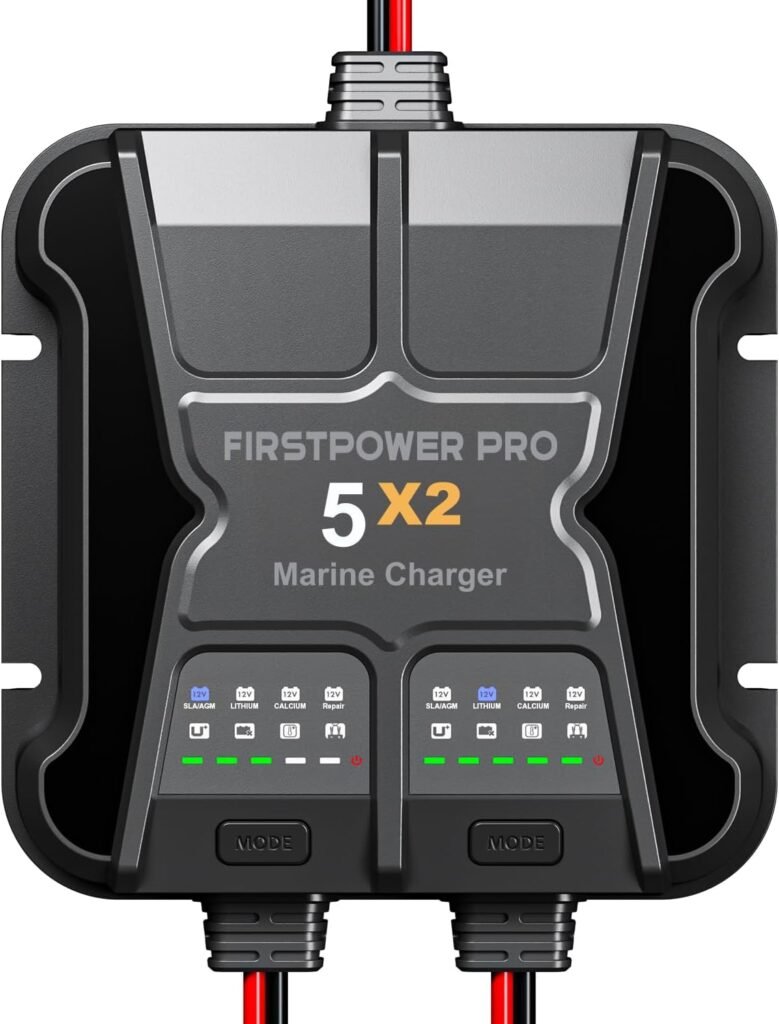
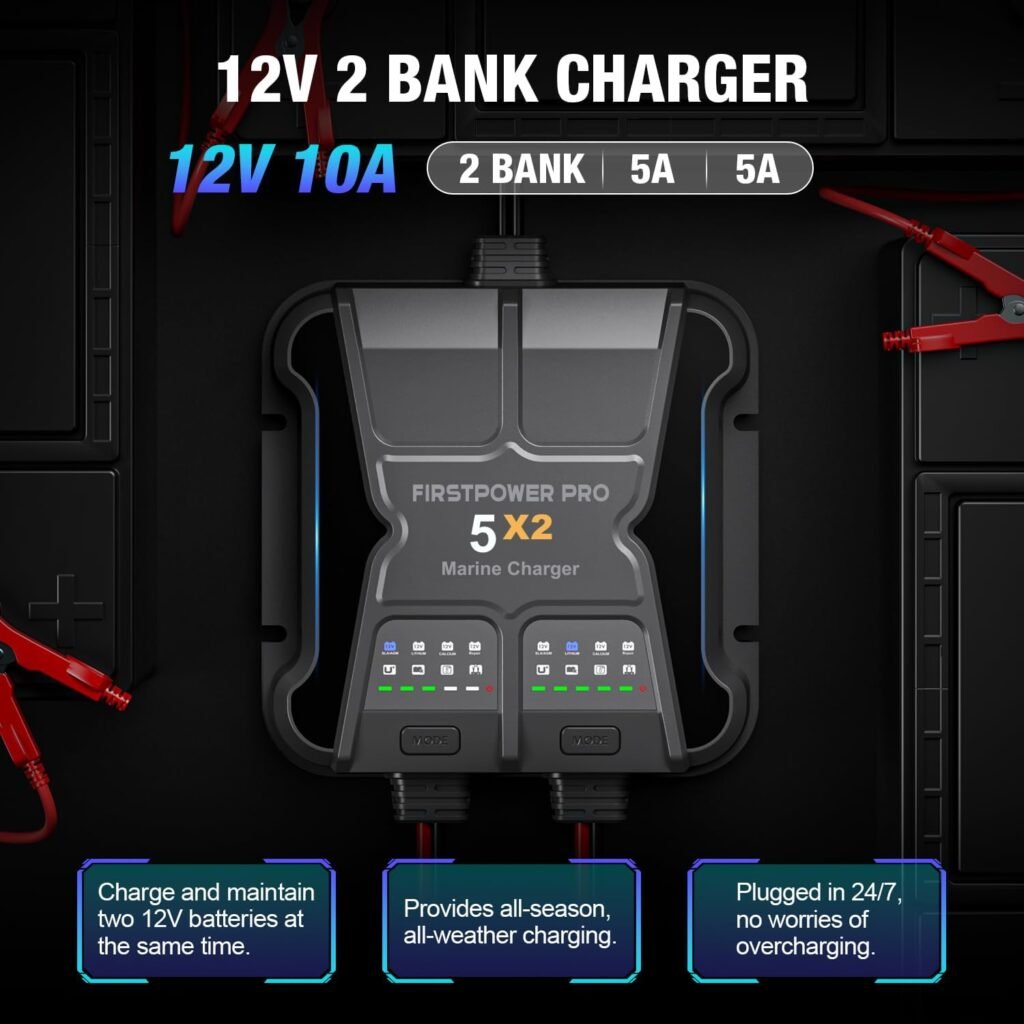
You want a charger that is compact, robust, and capable of handling multiple battery chemistries while sitting permanently onboard. The 2 Bank Marine Battery Charger 5X2, 10A (5A/Bank) – 12V Waterproof Onboard Boat Battery Charger Trickle Charger for SLA/AGM (Lead-Acid), Lithium (LiFePO4) Battery- Charged 24/7 is designed for exactly that purpose: two independent 5A channels with smart charging, waterproof construction, and onboard-ready features.
Key specifications
Here you’ll see the core numbers and labels that determine whether the unit fits your setup. The brief specs below summarize what matters most when you’re matching a charger to your batteries and your boat.
| Specification | Detail |
|---|---|
| Model type | 2 Bank, 5A per bank (Total 10A) |
| Voltage | 12V nominal |
| Battery types supported | SLA/AGM (Lead-Acid), Lithium (LiFePO4), Calcium |
| Charging modes | 3 selectable modes (SLA/AGM, LITHIUM, CALCIUM) |
| Waterproof rating | IP68 fully sealed |
| Continuous onboard use | Rated for 24/7 onboard charging |
| Force Mode | Manual start for very low voltage batteries (<1v)< />d> |
| Auto Repair | Automatic repair mode for recovery of sulfated or weak batteries |
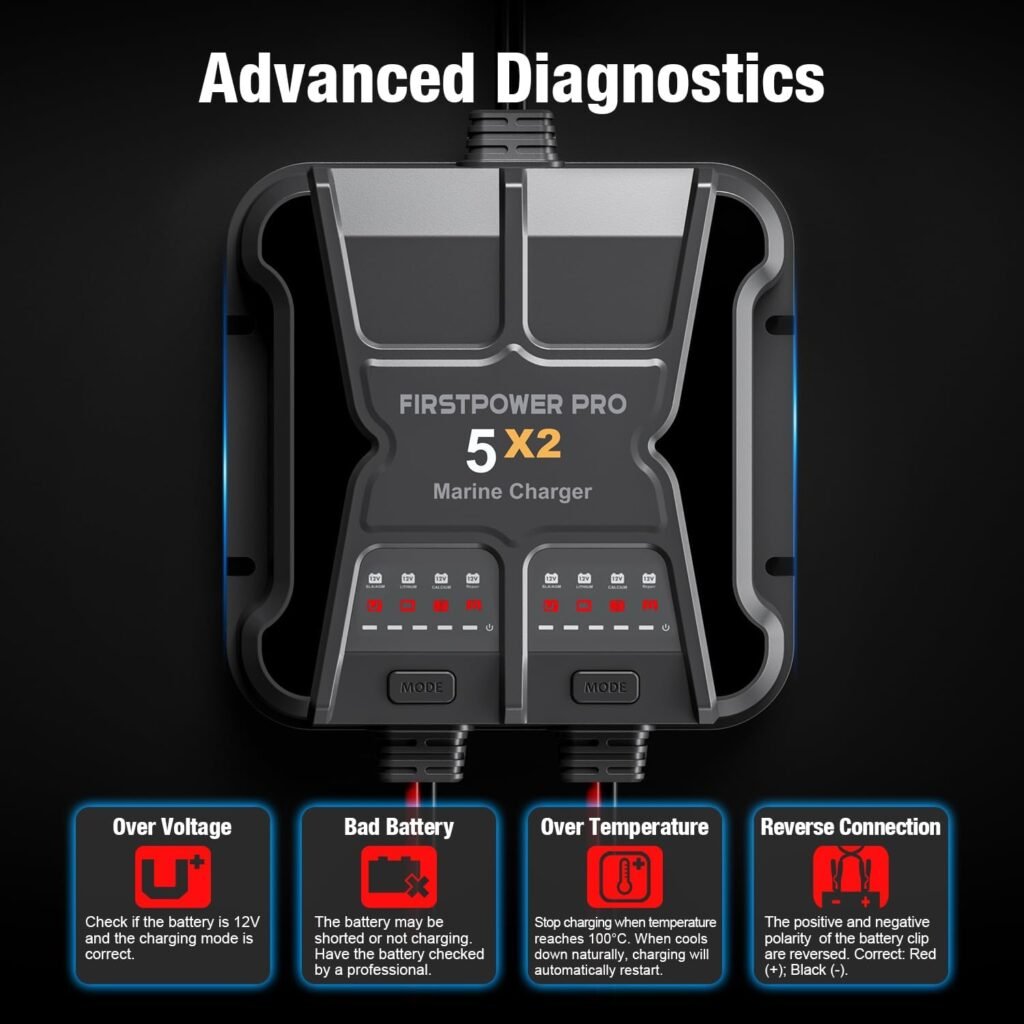
| Diagnostics | Over Voltage, Bad Battery, Over Temperature, Reverse Connection |
| Thermal compensation | Integrated thermal sensor for temperature-based charge adjustments |
| Indicators | 5-grid power display: 20% / 40% / 60% / 80% / 100% |
| In the box | Charger, 2 battery clips, 2 battery connectors, 2 spare fuses, 4 screws, bag, manual |
| Warranty | 3-year warranty for the charger |
What’s in the box
You should know exactly what arrives so you can plan mounting and wiring without surprises. The package includes the charger unit, battery clips and connectors, spare fuses, mounting screws, a small bag, and a manual to help get you started.
The included connectors make immediate bench or onboard setup possible, and the spare fuses are handy for replacing failures quickly while at the dock. If you plan to run long cable runs or hardwire the charger, you might add longer marine-grade cables and ring terminals.

Charging modes and battery compatibility
You’ll appreciate a charger that accepts different chemistries, because many boats use a mixed battery bank for starting and house loads. This charger offers three distinct 12V modes—SLA/AGM, LITHIUM (LiFePO4), and CALCIUM—so you can match the charge profile to the chemistry of each battery.
Using the correct charging mode ensures optimal charge acceptance and longevity; you can switch modes per bank independently so you can charge two different battery types simultaneously. This per-bank mode selection is especially useful when you have, for example, an AGM starter battery and a LiFePO4 house bank.
SLA/AGM mode
When you choose SLA/AGM mode, the charger uses a multi-stage algorithm tuned for typical flooded, sealed lead-acid, and AGM profiles. That means you’ll get bulk, absorption, and float stages suitable for maximizing capacity without overcharging.
SLA/AGM charging helps prevent gassing and excessive water loss in flooded types by controlling upper-end voltages and moving into float when the battery is full. That protection is especially valuable when the charger remains connected onboard for extended storage periods.
Lithium (LiFePO4) mode
If you use LiFePO4 batteries, selecting the Lithium mode optimizes charging voltages and termination behavior to match lithium chemistry. The charger recognizes lithium’s need for precise voltage control and reduced float behavior, helping you avoid damage from excessive voltage or prolonged high-voltage float.
LiFePO4 batteries accept high charge rates quickly and have different resting voltages than lead-acid types, so the dedicated mode helps you get full usable capacity while maintaining battery health. Because the charger has temperature compensation, it also reduces charge aggressiveness in cold conditions that could harm lithium cells.
Calcium mode
Calcium batteries, a subset of lead-acid designs, require a slightly different charging curve and higher absorption voltage than standard lead-acid. Selecting CALCIUM adjusts the charge algorithm to better match those requirements and helps you recover and maintain these batteries properly.
This is useful if you’ve upgraded certain banks to calcium alloy plates or found that a calcium battery needs a different maintenance voltage. Using the matched mode reduces the chance of undercharge or overcharge-related damage.
Simultaneous charging and per-bank control
You’re able to charge two batteries at once, each with an individually selectable mode, so the charger works flexibly with mixed battery systems. That means you can run house and start batteries with differing chemistries and still maintain both optimally without swapping chargers.
Independent channels also allow for isolated fault handling: if one battery shows a problem, the other channel can continue normal operation while you diagnose and address the issue.
Performance and charging behavior
Performance-wise, the charger provides 5A to each bank simultaneously, which is suitable for trickle charging, maintenance, and slow replenishment after moderate discharge. You should think of this as a maintenance/float charger rather than a rapid bulk charger; 5A is gentle and ideal for keeping batteries topped off.
For many smaller boats and battery banks, 5A per bank is a practical balance between charging speed and safety for continuous onboard use. If you have very large house banks or rapid recharge needs, you may consider a higher-amp charger or parallel charging strategies.
Current and bank distribution
The charger delivers a fixed maximum of 5A per bank, so each battery receives the same nominal current capacity independent of the other. You’ll see charging progress via the 5-grid LED display on each bank, which reports charge percentage in increments for easy monitoring.
Because the channels are independent, the charger can adjust the state for each battery separately, and if one battery reaches full charge before the other, that bank moves into a float state while the other finishes charging.
Force mode and recovery of dead batteries
If a battery is deeply discharged below 1V, you can manually initiate Force Mode by pressing and holding the MODE button for 5 seconds. This feature lets the charger attempt to revive deeply discharged cells by applying a low-level charge to bring voltage into a recoverable range.
Force Mode is helpful when you have a battery that other chargers refuse to start, but you should use it carefully: very low-voltage batteries may be physically damaged or unsafe, so inspect for bulging, odor, or other definitive signs of failure before attempting recovery.
Auto repair mode and advanced diagnostics
The charger includes an Auto Repair mode that automatically attempts to recover sulfated or weak lead-acid batteries; when it detects conditions suitable for repair, it lights the “12V Repair” indicator and initiates the process. You don’t need to perform manual steps for this function—just connect the battery and let the charger apply the programmed recovery routine.
Built-in diagnostics also look for faults like over voltage, bad battery condition, over temperature, and reverse connection, and the charger will indicate such states to help you identify issues quickly. That level of built-in intelligence saves you time by pointing to problems before they worsen.
Thermal compensation and precision charging
An integrated thermal sensor adjusts the charge voltage based on ambient temperature so that batteries are neither overcharged in hot conditions nor undercharged in cold ones. This is particularly useful if your boat spends seasons in variable climates and the charger remains installed year-round.
Precision charging improves battery lifespan by tailoring the charge to real-world conditions rather than a one-size-fits-all voltage, helping you maintain battery capacity and avoid heat-driven degradation.
Build quality and waterproofing
The IP68 fully-sealed rating means the unit is built to withstand permanent immersion at a specified depth for a specified time and to resist heavy water ingress while operating in wet marine environments. That allows you to mount it in bilge areas or other exposed locations without constant worry about spray and moisture.
The housing feels rugged and the connectors are designed with marine use in mind, but you should still protect the unit from direct physical impact and ensure wiring runs are secure. Corrosion on terminals is a common cause of issues across marine electronics, so attention to cable quality and protection is still necessary.
IP68 rating and onboard suitability
IP68 implies a high level of waterproofing, which is perfect for onboard chargers that may be exposed to spray or occasional immersion. You can be confident leaving the charger installed and connected while the boat is in service or during wet weather.
Despite IP68, you should still mount the charger in a location that avoids direct contact with heavy debris and long-term saltwater jets; routine inspection is recommended to ensure seals remain intact over time.
Mounting, connectors, and cables
The charger includes four screws for mounting and provides two sets of connectors—battery clips and battery connectors—to accommodate temporary or permanent connections. You’ll likely want to use the supplied connectors for testing and then hardwire the unit using ring terminals for a robust marine-grade installation.
Cables should be sized for short runs from battery to charger; longer cable runs require heavier gauge to prevent voltage drop which reduces effective charging current. If you’re unsure about cable gauge, consult a marine electrician or the charger manual for recommended wire sizes.
Installation and setup
Installing the charger is straightforward if you follow proper safety steps and wiring practices. You’ll mount the unit with the provided screws, connect the bank outputs to your batteries or battery combiner appropriately, and ensure fuses are in place before powering up.
The included manual gives a step-by-step procedure, but you should always disconnect power at the battery or isolate switches while routing cables and making permanent connections. If you don’t feel comfortable making the connections yourself, hire a qualified marine electrician to ensure safe and code-compliant installation.
Mounting steps
Choose a dry, accessible area that’s still within cable reach of your battery banks and avoid locations where the charger might be exposed to impact or heat sources. Use the four supplied screws to anchor the charger securely to a bulkhead or other flat surface, and ensure that the unit remains level and well-supported.
Leave a small amount of clearance for air to circulate and for the cable harness to exit without sharp bends, and route cables with clamps to prevent chafing or loosened connections from vibration.
Wiring and connector options
You’ll find both battery clips and more permanent battery connectors in the box; battery clips provide convenience for temporary connections while ring-terminal wiring is preferred for permanent installs. Install the supplied spare fuses in-line or in the circuit as directed, and consider installing an additional fuse close to the battery for extra protection.
Use marine-grade cable with the appropriate gauge and tinned copper to minimize corrosion, and secure all connections with crimped and heat-shrink sealed terminals for long-term reliability.
Selecting charging modes and using MODE button
Each bank has a MODE button that lets you pick between SLA/AGM, Lithium, and Calcium modes; press the button to cycle to the desired chemistry and then let the charger operate. For Force Mode, press and hold the MODE button for 5 seconds to force-start charging on a battery with voltage below 1V.
Always confirm you’ve selected the correct mode for each battery, because incorrect selection can impact battery life and safety. The LED indicator grid gives you a quick visual confirmation of charge stage and progress.
Safety features and warnings
Safety is paramount when working with batteries and boat electrical systems, and this charger offers protection features like reverse connection detection and over-temperature warnings. It’s still important that you use the charger in a well-ventilated area and observe basic battery safety—batteries can outgas hydrogen and pose explosion risk in confined spaces.
The product’s manual also warns to use in a well-ventilated area; you should heed that and ensure your charging area allows gases to dissipate. Avoid smoking or open flames near batteries, and wear eye protection and gloves when making connections.
Fuses and reverse connection protection
The charger includes spare fuses and built-in protection against reverse polarity, so accidental backwards hook-ups are less likely to damage the unit. If you do blow a fuse, the spare fuses let you restore operation quickly at the dock rather than having to run to a store or wait for replacement parts.
Despite these protections, you should still verify polarity before making connections—reverse connection protection is helpful but not a substitute for correct wiring practice.
Temperature, ventilation, and onboard use warnings
Because batteries produce hydrogen during certain charging phases, the charger’s instruction to use in a well-ventilated area is serious: you should never charge batteries in a fully sealed compartment without ventilation. The charger’s thermal sensor helps adjust charge in extreme temperatures, but the surrounding environment still needs airflow to dissipate gases safely.
In cold climates, consider insulating the batteries or moving them to a more temperature-stable location if practical; in hot climates, verify that the charger is mounted away from direct engine heat and that ventilation keeps ambient temperature within recommended operating limits.
Real-world use cases and scenarios
You’ll find this charger particularly well-suited to smaller boats, tenders, and vessels where a compact, always-on charger is necessary to maintain batteries between trips. Its dual-bank design makes it convenient for boats with separate starting and house batteries, and the IP68 rating lets you rely on it in wet environments.
It’s also a solid option for shore-based storage, as it can keep batteries topped off over winter while applying gentle, smart charging routines that reduce sulfation and extend battery life. You can use it on trailers, small RVs, and for standby engine batteries as well.
Boats and marine applications
For daily-use boats and weekender cruisers you’ll appreciate the small footprint, waterproof enclosure, and continuous charging capability. Mount it near the batteries or in an accessible bilge, and let it maintain your batteries while the boat is in storage or docked.
The ability to handle LiFePO4 and lead-acid simultaneously is especially useful if you’ve mixed your electrical system as you upgraded components over time. This charger lets you maintain both with a single unit.
RVs, garages, and seasonal storage
If you keep a battery in an RV or seasonal vehicle, you can install the charger to maintain batteries during storage periods. The precise charging and repair features help you avoid common failures caused by extended storage without maintenance.
Because the unit is small and simple to wire, it’s an easy add-on for shore power-equipped campers and trailers that need reliable trickle charging.
Starter batteries and deep-cycle batteries
You can use one bank for a starter battery and the other for a deep-cycle house battery, selecting modes appropriate to each. This makes the charger a practical, universal onboard solution if you don’t want multiple dedicated chargers.
Remember that 5A is slow for rapid recharge after heavy use, so for heavily-discharged deep-cycle banks you may prefer a higher-amp primary charger and reserve this unit for maintenance and float.
Pros and cons
You should weigh the strengths and limitations before committing to this charger so you know where it fits in your system. Below are succinct pros and cons to help your decision-making.
Pros:
- IP68 waterproof fully-sealed design suitable for onboard use.
- Two independent 5A banks let you charge two batteries or two banks simultaneously.
- Support for SLA/AGM, LiFePO4, and Calcium chemistries with per-bank mode selection.
- Force Mode for attempting recovery of deeply discharged batteries.
- Auto Repair mode and diagnostics for fault identification and battery recovery.
- Integrated thermal compensation for more accurate charging across climates.
- Compact and easy to mount; included connectors and spare fuses are convenient.
- 3-year warranty provides peace of mind for long-term use.
Cons:
- 5A per bank is intended for trickle/maintenance charging rather than rapid bulk charging.
- If you have very large house banks, charging time will be long and may require a higher-capacity charger.
- Although IP68, the unit should still be protected from physical damage and prolonged exposure to aggressive salt spray.
- Force Mode may not restore physically damaged batteries and should be used cautiously.
Comparison with similar chargers
When you’re comparing, think about what you want most: waterproofing, multi-chemistry support, independent channels, or higher amp output. This charger competes well on waterproofing and features, but other products may offer higher per-bank amperage or additional channels.
If you need faster recharge for large banks, a 20–40A single-bank charger or multi-bank high-amp charger may be a better choice. For small boats and mixed systems, the 5A-per-bank setup is often ideal because it focuses on maintenance and longevity.
2-bank vs 1-bank chargers
Two-bank chargers let you maintain separate batteries independently, which is important if your start and house batteries are of different chemistry or state of charge. A single-bank charger may be cheaper but requires switching or combining batteries, which risks cross-charging mismatched chemistries.
If you have only one battery or always parallel your batteries, single-bank options can be simpler. But if you value hands-off maintenance for two systems, a 2-bank charger saves you time and prevents user error.
Fixed output vs smart multi-stage chargers
Fixed-output chargers are simple and cheap, but they lack temperature compensation, diagnostics, and adaptive multi-stage charging. Smart multi-stage chargers like this one optimize battery life by varying voltage and current across bulk, absorption, and float stages and adding temperature compensation.
Those smart features pay off in extended battery life and fewer failures, making them a better investment if you care about battery health and long-term cost of ownership.
Maintenance and long-term reliability
To keep the charger working reliably, inspect wiring and connections periodically for corrosion and damage, and confirm that mounting seals and vent passages remain unobstructed. Replace fuses with the specified rating and use only recommended parts to maintain safety features.
The sealed enclosure reduces maintenance compared to non-waterproof units, but electrical connections and battery posts still need occasional cleaning, tightening, and protection with dielectric grease to minimize corrosion.
Battery maintenance while moored
You should leave the charger connected during long periods at the dock to keep batteries topped up and reduce sulfation risk. The Auto Repair and float functions handle much of the maintenance automatically so you don’t have to babysit charge cycles.
However, periodically inspect batteries for swelling, leaks, or abnormal heating, and measure open-circuit voltage to confirm battery condition beyond the charger’s LED indicators.
Firmware/hardware updates and service
This charger is primarily a hardware product, so firmware updates are unlikely; for long-term service, rely on the warranty and the seller’s support channels if something fails. Keep the receipt and register the unit if required to ensure warranty coverage.
If you run into persistent faults, the built-in diagnostics will guide you—document status lights and conditions when contacting support to speed repairs or replacement under warranty.
Troubleshooting common problems
When problems arise, you can usually identify the cause quickly by observing LEDs and following a few simple checks. Below are common issues and steps to resolve or confirm whether you need deeper service.
- No LEDs or charger seems dead: Verify shore power is present, check the fuse in the charger and the spare fuses, and confirm batteries are connected properly. If the charger still shows no life, try another outlet and, if applicable, verify the AC input cable and breakers.
- Charge not progressing or low current: Check cable gauge and length for voltage drop, inspect battery terminals for corrosion, and ensure the correct charging mode is selected for the battery chemistry. A deeply sulfated battery may take extended repair time or may be beyond recovery.
- Reverse connection / Bad battery indicator: Confirm polarity at the battery and the charger leads immediately. If connections are correct and the indicator persists, the battery may have an internal fault and require replacement.
- Over temperature or thermal shutdown: Move the charger to a cooler location if possible, and reduce ambient heat sources. Ensure ventilation and avoid mounting near engines or heat-emitting devices.
- Force Mode not reviving battery: If Force Mode can’t raise battery voltage and the battery shows bulging, odor, or cannot hold charge, replace the battery rather than risk a hazardous failure.
If basic checks don’t resolve the issue, contact the seller or manufacturer with diagnostic LED statuses and the actions you took so they can advise on warranty service or replacement.
Frequently asked questions (FAQs)
You probably have specific questions about everyday use—here are common ones with clear answers to help you decide and operate the charger.
Q: Can I charge a LiFePO4 battery and an AGM battery at the same time?
A: Yes, you can. The charger’s two independent banks let you select LiFePO4 mode for one bank and SLA/AGM mode for the other, so you can maintain both chemistries simultaneously.
Q: Is 5A per bank enough to charge my house bank?
A: It depends on battery capacity. For small to medium-size batteries used on tenders and day boats it’s often adequate for maintenance, but for large deep-cycle house banks a higher amp charger will recharge faster after heavy use.
Q: What does IP68 mean and how waterproof is it?
A: IP68 means the unit is designed to be fully sealed against dust and protected against continuous immersion to a specified depth and duration. While suitable for wet bilge environments, you should still avoid direct physical impacts and prolonged exposure to harsh spray.
Q: Can this charger recover a dead battery?
A: It has a Force Mode and an Auto Repair mode designed to start charging low-voltage batteries and recover some sulfated batteries. However, recovery is not guaranteed for physically damaged or severely aged batteries—use caution and inspect battery condition before attempting recovery.
Q: Where should I install the charger onboard?
A: Mount it in an accessible, ventilated area that’s protected from direct mechanical impact and away from high-heat sources. A bilge shelf or locker with ventilation is common, but ensure you have easy access to check LEDs and wiring.
Q: Are spare fuses provided and should I carry extras?
A: Yes, two spare fuses are included in the box. It’s a good idea to carry at least one or two additional fuses aboard for quick replacements when you’re away from shore supplies.
Q: What should I do if the charger shows a “Bad Battery” diagnostic?
A: Check connections, polarity, and battery terminal condition first; if the battery is corroded, damaged, or can’t sustain voltage, replacement may be necessary. If the charger indicates a bad battery but the battery tests good, consult manufacturer support for charger diagnostics.
Final verdict (concise summary)
You’ll get a compact, waterproof, and intelligent 2-bank charger ideal for maintaining two 12V batteries of different chemistries while aboard. It’s optimized for continuous onboard use, with features like Force Mode, Auto Repair, thermal compensation, and diagnostics that help protect and extend battery life.
This charger is best-suited to small-to-medium boats, RVs, and storage applications where 5A per bank is adequate for maintenance; if you need fast bulk recharge for large banks, consider a higher-amp option as a complement. Overall, if you want a reliable, marine-ready charger to keep your batteries healthy and reduce maintenance headaches, this model is a strong, feature-rich choice with a solid warranty to back it up.
Quick tips for getting the most out of the charger
You’ll want to follow a few practical tips to maximize performance and ensure safety during years of use. These simple habits will help your batteries last longer and keep your onboard power reliable.
- Always select the correct charging mode for each battery chemistry to avoid damage.
- Use marine-grade, tinned copper cables sized for the distance to minimize voltage drop.
- Mount the charger where you can see the LEDs and access wiring easily for inspection.
- Leave the charger connected during off-season storage to prevent sulfation.
- Replace fuses only with the specified rating and keep spares onboard.
- Periodically clean and protect battery terminals with dielectric grease to reduce corrosion.
- If a battery shows physical signs of failure, replace it—don’t rely on recovery modes for hazardous batteries.
If you follow these steps and use the charger as intended, you’ll keep your batteries healthier and avoid many common electrical issues encountered by boat owners.
Disclosure: As an Amazon Associate, I earn from qualifying purchases.