Are we curious whether the VTOMAN Jump 2200 Portable Power Station with Extra Battery is the right choice for our blackout kit, RV setup, or off-grid adventures?

Quick take on the VTOMAN Jump 2200 Portable Power Station
We find this to be a confident entry into the high-capacity, LiFePO4 portable power station category. Its expandable capacity, LIFEBMS safety suite, and dual PD 100W Type-C outputs make it appealing for both emergency use and daily off-grid needs.
What comes in the box and what to check right away
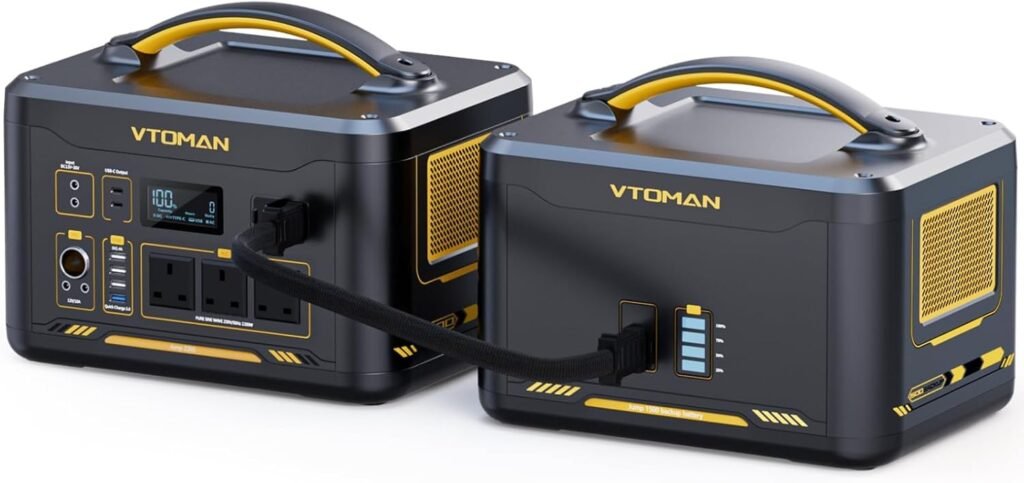
We appreciate that the package list includes the main Jump 2200 unit, an extra Jump 1500 battery, multiple charging cables, and a CP3500 cable for linking the extra battery. We recommend we check the product listing carefully before purchase because some model descriptions indicate the extra battery can be sold separately — confirm whether the seller is shipping the bundled extra battery or a single unit.
Design and build quality
The VTOMAN Jump 2200 feels robust and thoughtfully laid out for practical use. We like that the unit uses LiFePO4 cells inside a chassis meant for repeated field use, which typically translates to a durable product that will handle outdoor conditions and frequent transport better than many softer-case options.
Port layout and accessibility
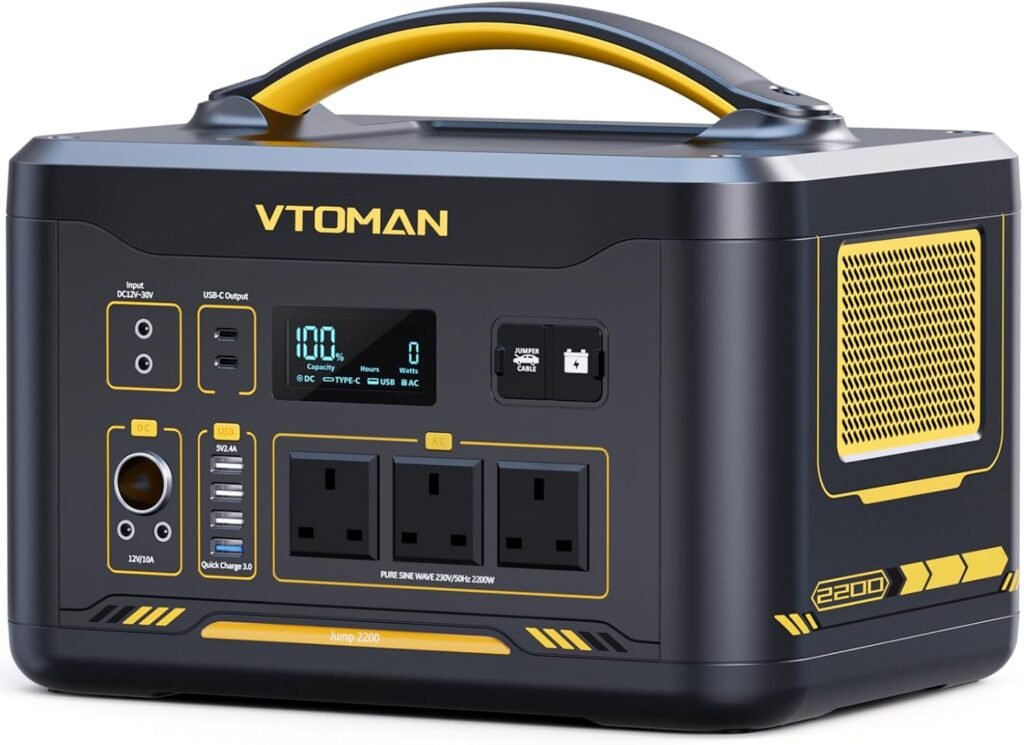
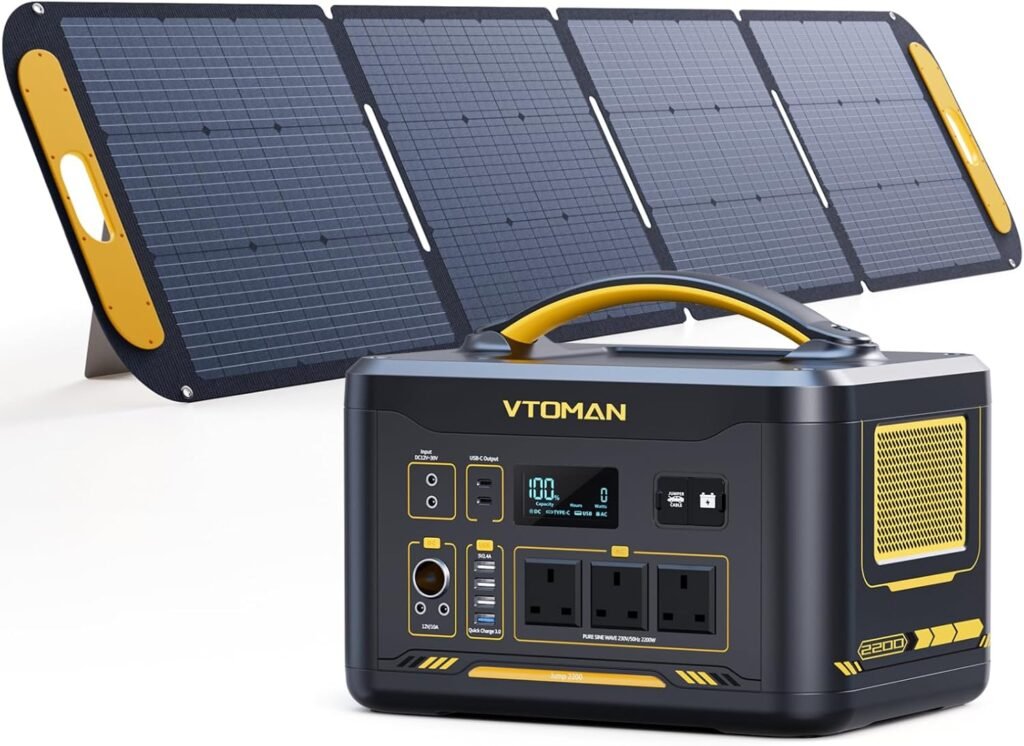
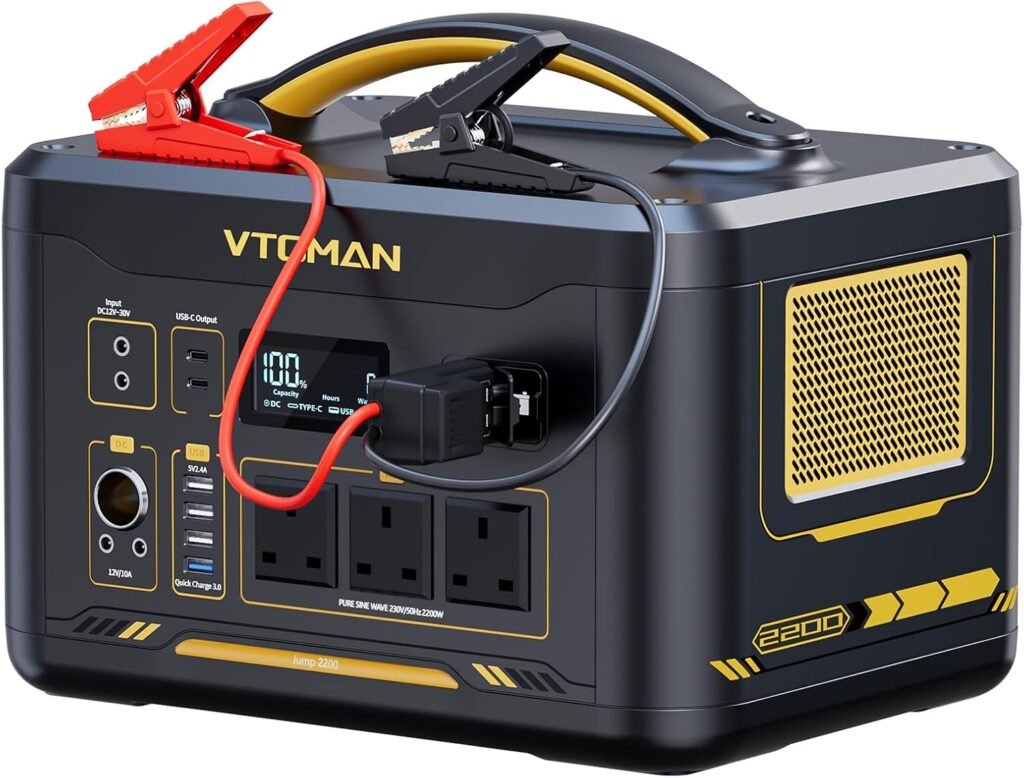
The front and side panels are arranged so we can access AC outlets, DC ports, USB-A, and dual Type-C PD ports without fumbling. The presence of three 230V AC outlets and multiple DC outlets in a single unit reduces the need for adapters and keeps our setup tidy when running several devices at once.

Key specifications at a glance
We find a compact specification table helpful for quick comparisons. Below we summarize the most important numbers and features reported in the product details.
| Specification | VTOMAN Jump 2200 |
|---|---|
| Battery chemistry | LiFePO4 (LFP) |
| Built-in capacity | 1548Wh |
| Expandable capacity | Up to 3096Wh (with Jump 1500 Extra Battery) |
| Cycle life | ~3,000 cycles to 80% capacity |
| Continuous AC output | 2200W (pure sine wave) |
| Surge output | 4400W |
| AC outlets | 3 x 230V / 2200W |
| DC5521 outputs | 2 x 12V/10A (regulated, total 120W) |
| 12V car port | 1 x 12V/10A (regulated, 120W max combined) |
| USB-A ports | 4 (including QC 3.0 18W) |
| USB-C Type-C ports | 2 x PD up to 100W each |
| Simultaneous devices | Up to 12 devices |
| Pass-through charging | Supported |
| BMS protections | Up to 10 protections (Over-charge, Over-discharge, Over-voltage, Over-current, etc.) |
| Included cables | AC adapter & cable, car charging cable, Type-C to Type-C, USB-A to Type-C, CP3500 cable, user manual |
Battery capacity, expandability, and lifespan
We like that the core unit ships with a sizable 1548Wh LiFePO4 battery that gives us long runtimes for many devices. When we require more endurance, adding the Jump 1500 Extra Battery can expand capacity to 3096Wh, effectively doubling how long we can run critical systems.
LiFePO4 advantages and what they mean for us
LiFePO4 chemistry offers higher thermal stability, longer cycle life, and better tolerance for repeated deep discharges compared with many NCM or lithium-ion chemistries. For us, that means less worry about battery degradation over years of use — VTOMAN’s spec of about 3,000 cycles to 80% capacity suggests many years of daily or frequent use before we see marked capacity drop.
Power delivery and the “2200W constant-power” claim
The VTOMAN Jump 2200 provides a pure sine wave AC output rated for 2200W continuous operation with a surge rating of 4400W. We find one notable claim here: the unit will still output 2200W constant power when powering appliances that attempt to draw over 2200W, rather than simply shutting off. Practically, this means it may act as an emergency fallback for higher-draw appliances by supplying the full 2200W it can sustain while preventing a hard shutdown. We recommend using caution and avoiding relying on this behavior as a guaranteed substitute for a correctly sized generator for high-demand appliances.
What “constant power” really implies for typical use
We understand this to mean the inverter will try to maintain the full rated output and will not trip off immediately if a load briefly exceeds 2200W. However, prolonged overcurrent conditions will still stress the system and could reduce efficiency or trigger protections. For high-power continuous loads like electric water heaters or large space heaters, an actual generator or a higher-rated inverter is still the safer choice.
Ports, outputs, and simultaneous charging
We are impressed by the breadth of output options: three AC outlets, two regulated DC5521 ports, a regulated 12V car port, four USB-A ports including QC 3.0, and two Type-C ports that each support up to 100W PD. The unit supports powering up to 12 devices at once — handy when we want to run a fridge, charge laptops, and power lights simultaneously.
Regulated 12V DC outputs — why that matters
All DC outputs are regulated 12V, which means they provide a steady voltage suitable for sensitive equipment such as car refrigerators, CPAP machines, and portable coolers. Because the three DC ports share a combined maximum output (120W total for DC ports), we need to account for that when planning to run multiple DC devices at once.
USB-C PD and laptop-friendly charging
The two Type-C PD ports can supply up to 100W each, which lets us charge high-demand devices like power-hungry laptops and fast-charge tablets or phones. For remote workers or creatives on the road, this is a significant convenience: we can run a laptop and charge phones without needing separate adapters.
Charging methods and recharging procedure
The Jump 2200 supports multiple charging inputs: AC adapter (wall), car charging, and solar panels. If we add the Jump 1500 Extra Battery, we connect it to the main unit using the included CP3500 cable, then plug AC, car, or solar input into the Jump 2200 to charge both the main unit and the extra battery together. This unified charging pathway simplifies our workflow and limits the number of chargers we need to manage.
Practical notes on charging times and strategies
Charging times depend heavily on the input source and wattage available. Wall charging via a high-wattage adapter is typically the fastest and most consistent option; solar charging depends on panel wattage, sunlight, and charge controller limits. For extended trips we recommend using a mix of AC (when available) and solar input to keep both the main and extra battery topped up and ready.
Real-world runtime estimates (practical examples)
We find it helpful to translate watt-hours into practical runtimes for everyday appliances. The following table offers conservative estimates using the 1548Wh base capacity and the expanded 3096Wh capacity. Note these are approximations — actual runtime varies by device efficiency, inverter conversion losses, and the device’s duty cycle.
| Device | Typical draw (W) | Estimated runtime @1548Wh | Estimated runtime @3096Wh |
|---|---|---|---|
| Smartphone (10W) | 10W | ~120 hours (many full charges) | ~240 hours |
| Laptop (60W) | 60W | ~20–22 hours | ~40–44 hours |
| CPAP machine (40W average) | 40W | ~34–36 hours | ~68–72 hours |
| LED TV (60W) | 60W | ~20–22 hours | ~40–44 hours |
| Mini fridge (60–100W average) | 80W avg | ~16–18 hours | ~32–36 hours |
| Electric kettle (1500W) | 1500W | ~0.9 hours (single boil cycles) | ~2 hours (limited cycles) |
| Microwave (1000W) | 1000W | ~1.3 hours (intermittent use) | ~3 hours (intermittent use) |
| Space heater (1500W) | 1500W | ~0.9 hours | ~2 hours |
We emphasize that high-wattage resistive loads (kettles, heaters, ovens) consume large amounts of energy in short periods, so while the inverter can handle high surge demands, the runtime will be short on battery-only power. For appliances intended for extended continuous use, we recommend a larger capacity or a hybrid solution with a generator.
Surge capacity and starting loads
The 4400W surge rating helps when starting inductive loads such as refrigerators, pumps, or tools with high starting current. We find this useful for appliances that briefly draw more power to kick-start the motor; the inverter’s surge headroom improves compatibility with a wider range of home and RV appliances.
Pass-through charging — using while charging
The VTOMAN Jump 2200 supports pass-through charging, which lets us use outputs while the unit is recharging. This is convenient at events or during an outage when the unit can power devices and replenish battery simultaneously. We recommend using pass-through cautiously for long periods and ensure adequate ventilation because concurrent heavy charging and discharging can generate heat.
Practical use scenarios where it shines
We see multiple practical scenarios: as a home backup for light-to-moderate loads during blackouts, as a primary power hub for RVs and vans, and as a campsite central for electronics, lights, and small appliances. The regulated DC ports and PD 100W ports also make this unit a strong choice for medical devices like CPAP machines and for remote work setups.
Using it in a home blackout
For home backups, we suggest prioritizing essential circuits and devices: phone chargers, Wi-Fi/router, LED lights, a fridge on rotation, and medical devices. With the expanded capacity option, we can stretch autonomy for longer outages without constantly worrying about immediate recharging.
Using it for RV and van travel
For RVers and vanlifers, the VTOMAN’s regulated 12V outputs and car port profile well with DC appliances and a wide variety of camping gear. The portability and PD ports make charging laptops and cameras straightforward, and the extra battery option is valuable if we plan extended boondocking.
Safety and the SuperSafe LIFEBMS system
VTOMAN’s SuperSafe LIFEBMS provides up to 10 protections, including over-charge, over-discharge, over-voltage, and over-current protection. We appreciate that these built-in protections are designed to protect both the battery and connected devices. Along with LiFePO4 chemistry’s inherent thermal stability, the BMS contributes to safer operation in varied conditions.
Portability, handling, and real-world carry
Given the LiFePO4 battery and the included extra battery in some bundles, we should expect a substantial weight — typical for high-capacity LFP units. We find the carry handles and design make movement manageable, but this is not a pocketable device; it’s a portable power hub that benefits from a cart, vehicle trunk, or two-person lift for long transfers.
Maintenance and longevity tips
We recommend keeping the unit in a temperate environment and avoiding prolonged exposure to high temperatures to preserve battery life. Regularly cycling the battery (using and recharging) helps maintain capacity. When storing long-term, we suggest storing the battery at a partially charged state (around 40–60%) and checking battery levels every few months.
Pros — what we like
- Robust LiFePO4 chemistry with long cycle life (≈3,000 cycles to 80%).
- Expandable capacity up to 3096Wh for extended off-grid use.
- 2200W continuous pure sine wave output with 4400W surge capacity.
- Dual PD 100W Type-C ports for fast charging of laptops and modern devices.
- Multiple regulated 12V DC outputs suitable for sensitive DC appliances.
- Pass-through charging and the ability to charge extra battery via CP3500 cable.
- Comprehensive BMS protections for safer operation.
Cons — potential drawbacks to consider
- LiFePO4 and the extra battery add weight, making it heavier than smaller portable stations.
- High-draw appliances will still drain the battery quickly despite the unit’s high inverter capacity.
- Some listings and package descriptions may be inconsistent about whether the extra battery is included or sold separately; confirm with the seller.
- We don’t see a built-in MPPT specification or exact maximum solar input in the supplied details, so we need to verify exact solar charging rates before planning large solar-only recharge strategies.
How VTOMAN Jump 2200 compares to similar products
We find VTOMAN’s strengths in its combination of LiFePO4 chemistry, high continuous inverter rating, and expandability. Compared to many consumer-grade power stations that cap at 1500W continuous and use NCM cells, the Jump 2200 offers higher power headroom and longer service life. For users wanting a balance of durability, power, and the ability to scale capacity, this unit is competitively positioned.
Frequently asked questions we get asked
Q: Can we run a full-size electric stove or oven from this unit? A: Not for extended use. While the inverter can supply up to 2200W continuous, traditional electric stoves and ovens often draw more power, especially during heating cycles. For short, emergency operation the unit may supply partial function, but it’s not a replacement for a full genset for heavy cooking loads.
Q: Can we chain more than one extra battery? A: The product details mention expansion with the Jump 1500 Extra Battery to reach 3096Wh. We recommend checking VTOMAN’s official docs or asking support about chaining multiple extras beyond the stated configuration before purchasing multiple extra batteries.
Q: Is the unit safe for medical devices? A: Yes, regulated 12V outputs and a pure sine wave inverter are suitable for many medical devices including CPAP machines. We advise verifying device-specific starting currents and consult the device manufacturer if in doubt.
Q: Can we fast-charge the extra battery with solar? A: The Jump 2200 supports solar charging for the unit and extra battery together when connected via the CP3500 cable. Actual solar charge rates depend on the solar panel wattage and the charge controller capabilities. Confirm the maximum supported solar input on the seller’s specs for precise planning.
Practical tips for getting the most from the VTOMAN Jump 2200
- Prioritize essential loads during blackouts — lights, communications, refrigeration, and medical devices.
- Use the PD 100W ports to consolidate laptop charging and avoid carrying multiple bulky chargers.
- When planning solar recharge, size solar arrays conservatively and be mindful of seasonal and daily sunlight variance.
- Keep the CP3500 cable accessible if we plan to use the extra battery frequently; it’s central to charging both units together.
- Check for firmware or BMS updates from VTOMAN if they provide them, as those can improve performance and safety over time.
Final recommendation
We think the VTOMAN Jump 2200 Portable Power Station with Extra Battery is a compelling option for users who need durable, scalable, high-power portable energy. For households seeking a reliable blackout solution, vanlifers needing regulated DC and strong laptop charging, and campers wanting long runtimes, this unit hits many practical needs. We recommend confirming whether the extra battery is included in the specific product listing you are viewing, matching expected loads to the inverter rating, and planning for how you’ll recharge the system on extended off-grid trips.
Summary of our view
We appreciate VTOMAN’s emphasis on safety (SuperSafe LIFEBMS), long-life LiFePO4 chemistry, and the capacity to expand to over 3kWh with an extra battery. The 2200W continuous output and 4400W surge capability give us flexibility to run many appliances, while dual PD 100W Type-C ports make it modern-device friendly. With thoughtful planning around energy consumption and recharge strategy, we believe this power station can be a core part of our emergency kit, mobile office, or off-grid lifestyle.
Disclosure: As an Amazon Associate, I earn from qualifying purchases.