Are you trying to decide whether the Generic Lifepo4 Battery 12 V 100 Ah Compatible with Multiple Devices 1280 Wh Deep Cycle Energy Storage Battery with 100 A BMS is the right power solution for your RV, solar setup, or emergency backup?

Quick verdict
You get a very portable, high-cycle-life LiFePO4 battery with a solid feature set for mobile and stationary use. If you want a lightweight replacement for lead-acid batteries that supports building larger banks and offers robust protection through a 100A BMS, this battery will likely meet most needs while keeping maintenance low.
Product overview
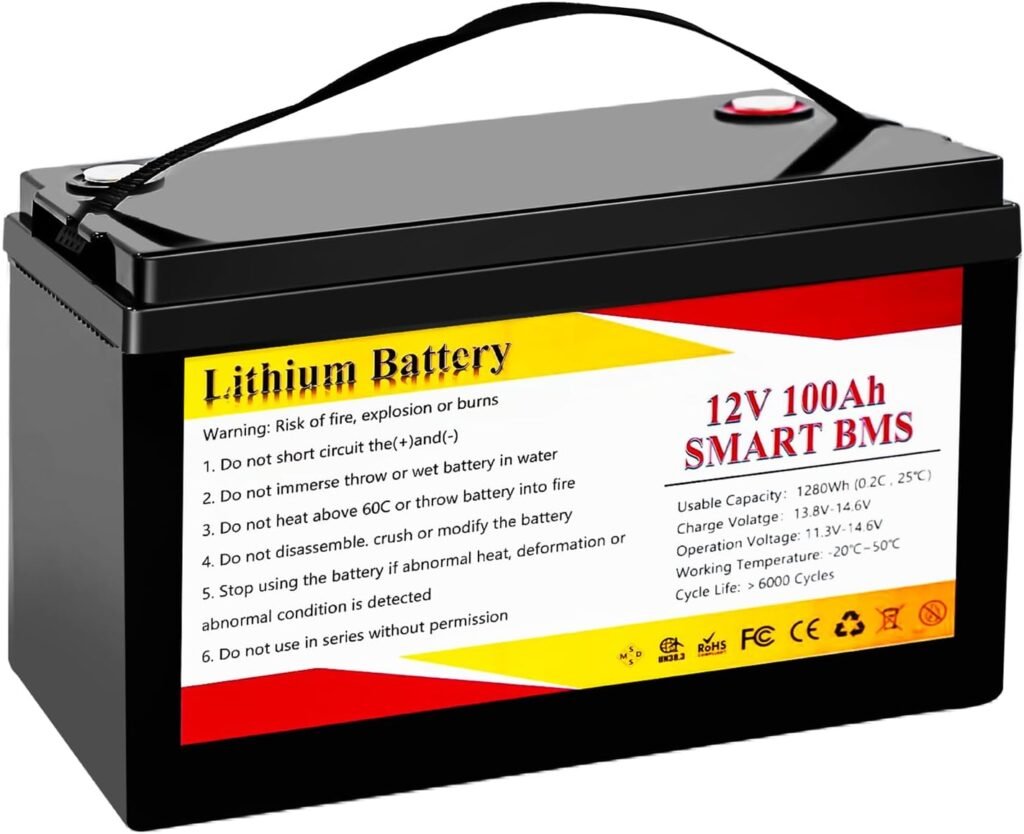
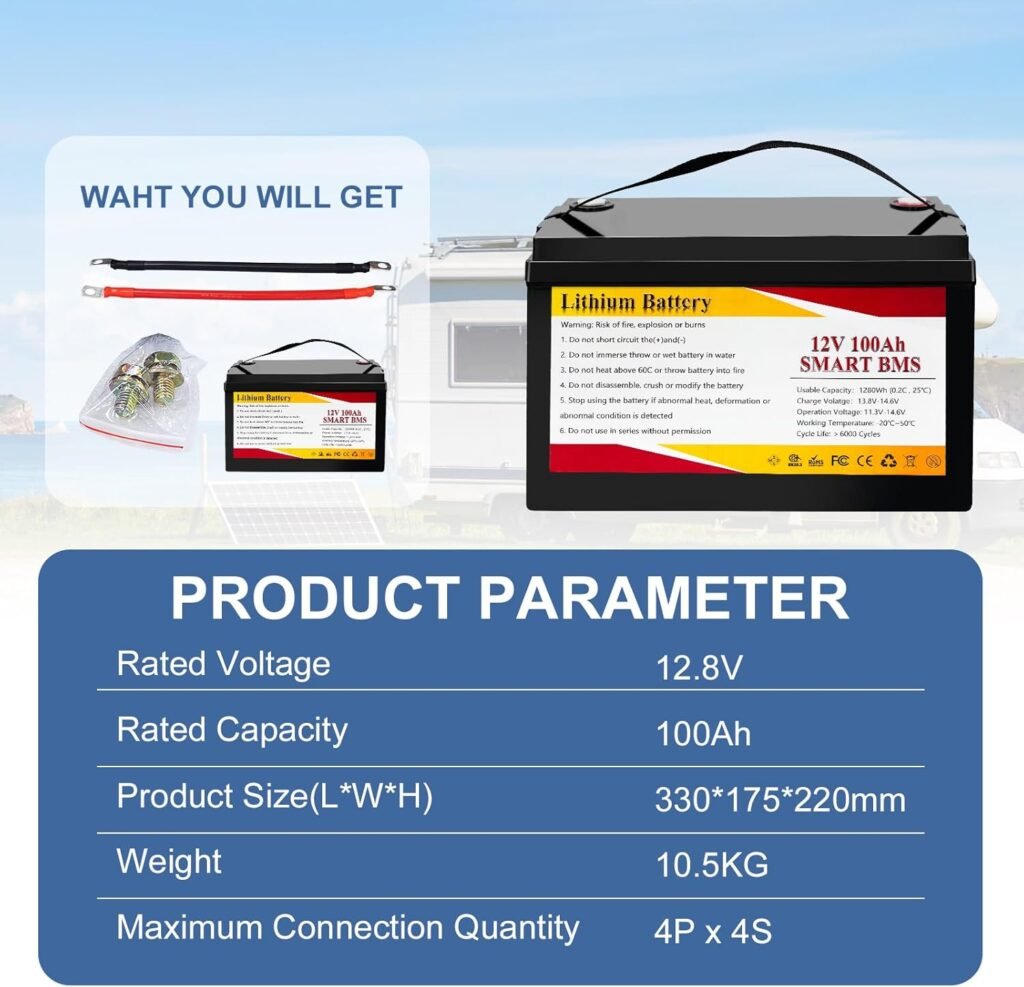
You’re looking at a 12.8V, 100Ah LiFePO4 deep-cycle battery that stores about 1280Wh of usable energy by nominal rating. The pack includes basic installation hardware and short 20cm power cables, and it’s designed to be easily paralleled and series-connected up to a 4P4S configuration for higher voltage and capacity.
Key specifications
This section lays out the core specs you need to evaluate compatibility with your devices and systems. You’ll find raw numbers useful for sizing inverters, chargers, and fuses.
| Item | Specification |
|---|---|
| Nominal voltage | 12.8 V |
| Nominal capacity | 100 Ah |
| Energy | 1280 Wh |
| Chemistry | LiFePO4 (LFP) |
| BMS | 100 A Peicheng BMS (built-in) |
| Cycle life | >4,000 cycles |
| Typical lifespan | 6–8 years (depending on use and environment) |
| Weight | 10.5 kg (25.3 lb) |
| Expandability | Supports up to 4P4S (up to 51.2V, 400Ah) |
| Certifications | ISO9001 / CE / UL (claimed) |
| Package includes | Battery, screws, 20 cm cable (one black, one red) |
What’s in the box
You’ll receive a single battery with the short wiring and mounting screws needed for basic installation. Keep in mind the included cables are short and meant for connection to a terminal or a busbar; for your inverter/charger you’ll typically replace those with appropriately sized cabling.
Performance and capacity
You can expect consistent voltage under load and a flatter discharge curve compared to lead-acid batteries. That helps devices run closer to their expected power requirements for longer before voltage sag becomes an issue.
Real-world runtime estimates
Because the battery stores 1,280 Wh, you can estimate runtimes by dividing that energy by your device’s power draw. For example, a 50 W LED refrigerator light would last roughly 25 hours; a 300 W TV could run for about 4 hours under ideal conditions. Remember that inverter efficiency and actual discharge depth will reduce those values somewhat, so plan conservatively.
Charging and discharging behavior
LiFePO4 chemistry accepts higher charge currents and maintains stable voltage until near depletion, so you’ll see less sag than with lead-acid batteries. The built-in 100A BMS limits discharge current to protect the cells, which means your maximum continuous output will be around 1,280 W at 12.8 V (minus inverter losses) unless you bypass the BMS—which you should never do.

BMS and safety features
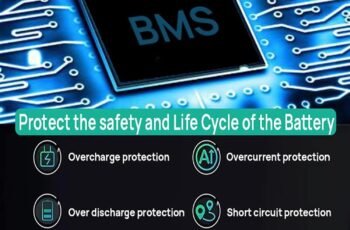
The integrated 100A Peicheng BMS is central to safe operation. It handles current limiting, cell balancing, overcharge and over-discharge protection, and temperature monitoring that reduces your risk of catastrophic failure.
100A BMS details
You should plan system components around the BMS rating: continuous discharge is limited to 100A and the same general limit applies for charge current protection. For short bursts, some BMSs allow higher peaks, but you should assume continuous operation must stay at or below the BMS rating to avoid tripping protection or stressing components.
Certifications and reliability
The claim of ISO9001, CE, and UL certifications indicates the manufacturer follows some quality and safety standards. You should still verify the seller’s documentation and any local regulatory requirements for installations in vehicles, boats, or tied-to-grid solar systems.
Lifespan and durability
The LiFePO4 chemistry is known for excellent cycle life, and this pack promises more than 4,000 cycles. In practical terms, that means many years of heavy use before capacity noticeably declines, assuming you don’t expose the battery to extremes of temperature or abusive charge/discharge patterns.
Cycle life and calendar life
A rated cycle life of 4,000 cycles typically assumes cycling to a defined depth of discharge (often 80–100% for LFP with modern management). In real usage, if you cycle daily, you can expect multiple years of consistent use. The quoted 6–8 year lifespan aligns with typical residential and mobile use, though calendar life can vary with storage temperature and charge state.
Temperature and environmental robustness
LiFePO4 performs well in warm conditions and is more tolerant of abuse than many other chemistries, but low temperatures (below 0°C/32°F) reduce charging effectiveness and may require a temperature-controlled environment for charging. The built-in BMS helps by blocking charge below safe temperatures on many packs, but be sure to confirm the battery’s specified operating temperature window if you expect to use it in very cold climates.
Size, weight, and portability
At 10.5 kg (25.3 lb) this battery is roughly one-third the weight of equivalent lead-acid systems, which makes it convenient to move and install. You’ll find it particularly beneficial for RVs, campers, or portable power stations where weight and compactness matter.
Form factor implications
Because it’s lighter and more compact, you can mount more capacity in the same space or simply reduce the space used for your battery bank. That said, ensure any mounting surface is stable and protected from vibration and moisture, especially in vehicles or boats.
Capacity expansion and building a battery bank
The product supports up to 4P4S connections, allowing you to assemble larger banks with both series and parallel configurations. You can scale voltage up to 51.2V and capacity up to 400Ah if you wire 4 in series and parallel appropriately.
Series/parallel wiring guidance
When you assemble batteries in series to increase voltage or parallel to increase capacity, you must ensure all units are the same model, state of charge, and age for safe, balanced operation. If you build a 4S (four in series) pack to achieve 51.2V, you must wire them correctly and ensure communication/monitoring for safe balancing.
Matching cells and balancing
Because the battery contains its own BMS, some balancing is handled internally, but when creating multi-battery banks you still need to balance initial states and avoid mixing batteries with different histories. Use identical batteries from the same batch if possible, and charge them to the same SOC before connecting.
Use cases and suitability
You can use this battery for a variety of applications, including RV house banks, solar off-grid systems, portable power stations, emergency backup, marine electronics, and small electric propulsion or trolling motors. Its relatively high cycle life and light weight make it a solid multi-purpose choice.
RV and camper applications
In an RV you’ll appreciate the weight savings and longer usable depth of discharge compared with lead-acid batteries. You can run lighting, water pumps, and electronics for longer periods, and you’ll likely need fewer batteries to achieve the same usable capacity.
Solar and off-grid systems
For small off-grid systems, the battery’s expandability up to 51.2V and 400Ah is attractive because you can scale capacity and voltage for inverters and charge controllers that prefer higher nominal voltages. Pairing with an MPPT charge controller that supports LiFePO4 charging profiles will help achieve faster and safer charging.
Emergency backup and portable power
Because of its high cycle life and low self-discharge, the battery is a good choice for emergency backup. You can also use it in portable power stations for weekend trips; just remember the integrated BMS current limit when sizing inverters for motor-driven appliances.
Installation and setup tips
Install the battery in a dry, ventilated space and secure it to prevent movement. Always use proper terminal covers and install a fuse or DC breaker close to the battery to protect wiring and downstream devices.
Fusing, connectors, and cable sizing
Since the battery’s BMS is rated to 100A, select fusing and cable sizes to handle the continuous current safely—typically a fuse near the battery positive and cables sized for 100A continuous (e.g., AWG 2/0 or the local equivalent, though exact sizing depends on cable length and installation). Place the fuse within 10–30 cm of the battery positive terminal to protect the cable from short circuits.
Mounting and ventilation
You don’t need to vent LiFePO4 like lead-acid batteries, but you should avoid enclosed spaces with high heat. Mount on a flat, vibration-resistant surface and protect the battery from moisture and salt if used in marine environments.
Charging systems and inverter pairing
Choose a charger and inverter that match the battery’s voltage and BMS limits. For charging, LiFePO4 requires a slightly different voltage profile than lead-acid batteries.
Recommended charge settings
A typical LiFePO4 bulk/absorb voltage sits around 14.2–14.6 V for a 12.8 V nominal pack. Float charging is often unnecessary; if you use float, keep it around 13.4–13.6 V to avoid stressing the pack. Use an MPPT charge controller or a charger that allows you to set LiFePO4 parameters to ensure safe and efficient charging.
Inverter sizing and continuous vs. peak current
Because the battery’s BMS limits continuous output to 100A (around 1,280 W), you should match your inverter’s continuous draw expectation to that limit. If you need short peaks above 1,280 W (for motor starting, for instance), confirm whether the BMS supports short bursts above 100A without tripping. In many systems you’ll size the inverter’s continuous rating below the BMS limit and rely on the inverter’s surge handling for short peaks.
Pros and cons
You’ll benefit from many advantages, but there are trade-offs to be aware of before purchasing.
Pros
- Very high cycle life (>4,000 cycles) meaning long-term savings.
- Lightweight (10.5 kg) and compact compared to lead-acid alternatives.
- Built-in 100A BMS offers comprehensive protection and reduces setup complexity.
- Expandable up to 4P4S for flexible system design.
- Lower maintenance and no need for ventilation like lead-acid batteries.
Cons
- 100A BMS sets a continuous power ceiling around 1.28 kW, which limits some high-power appliances or requires multiple batteries.
- Short included cables mean you’ll likely buy thicker, longer cables for full installations.
- For very cold climates, you must manage charging carefully because LiFePO4 charging below freezing can be restricted.
- If warranties or local support are limited, replacements or RMA may be harder in some regions.
Troubleshooting and common issues
If you face problems, start with the basics: check wiring, fuses, and state of charge. Many issues that appear like battery faults are simple installation or configuration mistakes.
BMS trips and resets
If the BMS trips for overcurrent or voltage anomalies, reduce the load or charging current and allow the BMS to reset if it supports automatic restart. If it doesn’t reset, isolate the battery, check connections and fuses, and consult the seller or a professional. Repeated trips indicate mismatched loads or wiring errors.
Unexpected voltage behavior
If the battery shows unusual voltage swings, check for loose terminal connections and ensure the charger and inverter settings match LiFePO4 profiles. Paralleling batteries that aren’t at the same SOC or age can also cause balancing issues and odd voltages.
Practical examples and math for sizing
You can use these quick math points to size your system or estimate runtime.
- To estimate run time: Runtime (hours) = 1,280 Wh / Device power (W). Factor inverter efficiency (typically 85–95%) and plan conservatively.
- Charging time estimate: Charging time (hours) = Battery capacity (Ah) / Charge current (A) × efficiency factor (1.05–1.2). For example, at 20A charging: 100 Ah / 20 A = 5 hours, plus some overhead, so ~5.5–6 hours to full. At 50A charging: ~2.2–2.5 hours.
- Inverter continuous power: BMS 100A × 12.8 V ≈ 1,280 W continuous; account for inverter inefficiencies and heat, so expect 1,100–1,200 W usable continuous.
Maintenance and storage advice
You won’t need the same level of maintenance as lead-acid, but some care extends battery life dramatically. Keep it charged in storage, avoid full depletion, and store within the recommended temperature range.
Storage SOC and temperature
For storage, keep the battery around 30–60% SOC to reduce stress on cells over long periods. Avoid storing fully discharged or fully charged for long durations. Store in a cool, dry place, ideally between 10–25°C (50–77°F) for best calendar life.
Periodic checks
Every few months check terminal tightness, look for corrosion, and verify the battery voltage. If long-term storage is planned, occasionally apply a top-up charge to keep the SOC in the recommended window.
Compatibility and devices
This battery can power a wide range of devices but you should always confirm power requirements and inrush currents before connecting high-startup-current equipment.
Devices that work well
- LED lights, fans, and modern electronics.
- Small refrigerators, pumps, and low-power appliances well under the continuous power limit.
- Small inverters for laptops, TVs, and chargers.
- Solar charge controllers when configured for LiFePO4.
Devices to be cautious with
- Large AC motors, microwave ovens, and heavy-duty power tools that draw sustained power above the 1.28 kW continuous limit.
- Devices with very high startup currents unless you can confirm the BMS and wiring will handle surges.
Warranty, support, and buying considerations
Before buying, confirm warranty length and coverage, seller reputation, and availability of replacement or technical support. The long life claims are appealing, but warranty terms matter if a pack fails prematurely.
Questions to ask the seller
Ask about the length and terms of warranty, what constitutes a warranty claim, and how returns or RMAs are handled. Confirm documentation for certification claims (CE/UL/ISO9001) and whether replacement cells or packs are readily available in your region.
Final recommendation
If you want a lightweight, long-lasting LiFePO4 option for everyday mobile power or off-grid setups and you don’t need sustained output above about 1.3 kW from a single battery, this Generic Lifepo4 Battery 12 V 100 Ah Compatible with Multiple Devices 1280 Wh Deep Cycle Energy Storage Battery with 100 A BMS is a practical and cost-effective choice. It gives you flexibility to scale up to a larger system, reduces maintenance compared with lead-acid, and offers a long usable life that should pay back the initial cost over time.
Make sure you size your inverter and cabling for the BMS limit, plan for colder climates if relevant, and confirm warranty and seller support before purchase. With the right setup and usage, this battery can become a reliable backbone of your mobile or stationary power system for years to come.
Disclosure: As an Amazon Associate, I earn from qualifying purchases.