? Are these LiFePO4 3.2V 280Ah cells a good fit for our home solar or RV battery needs?

Quick verdict
We like what this product offers for people who want a compact, high-capacity LiFePO4 building block for a 12V system. The cells are Grade A tested for voltage and internal resistance before packaging, come with the hardware we need, and have the kind of long cycle life LiFePO4 is known for. With the right BMS, wiring, and installation, these cells can form a robust 12V 280Ah bank for home solar storage or RV use.
Product specifications (at a glance)
Below we summarize the key specs from the listing and the practical values we rely on when planning a battery pack. This helps us compare features quickly and plan installation and charging gear.
| Parameter | Value | Notes |
|---|---|---|
| Cell type | LiFePO4 (Lithium Iron Phosphate) | Chemically stable and long-lived |
| Nominal voltage per cell | 3.2 V | Standard LiFePO4 nominal |
| Rated capacity | 280 Ah | Measured under manufacturer conditions |
| Recommended full charge per cell | ~3.6–3.65 V | Typical LiFePO4 charge ceiling |
| Pack option | 4 PCS / LOT | Four cells included — suitable for 12.8V nominal pack |
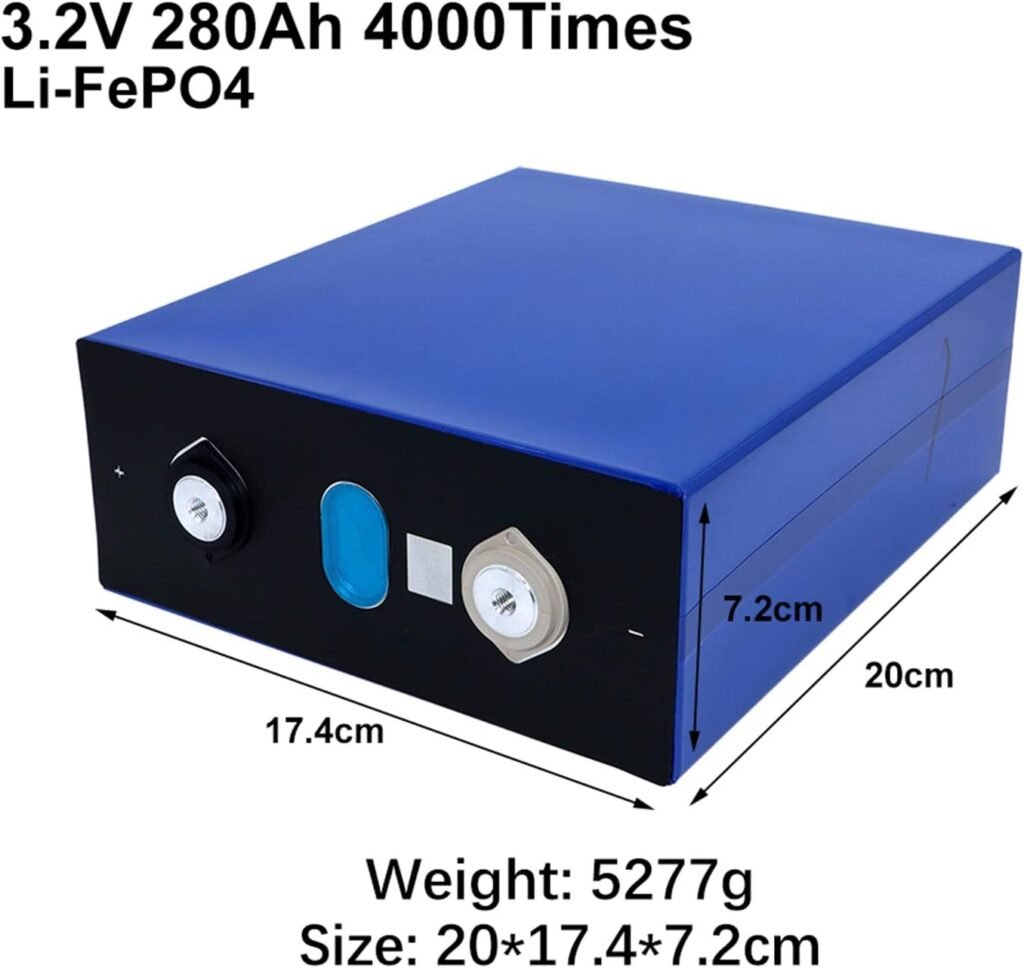
| Size (L×W×H) | 205 mm × 174 mm × 72 mm | Compact for 280Ah capacity |
| Weight per cell | 5 kg | Manageable for handling and mounting |
| Accessories included | Screws, plugs, bus bars | Helpful for series assembly |
| Grade | A performance | Voltage and internal resistance tested before packaging |
| Expected service life | 5–15 years / 2000–8000 cycles | Wide range depending on depth of discharge and conditions |
| Pre-packaging tests | Voltage and internal resistance checks | Cells are balanced for consistency |
Physical dimensions and handling
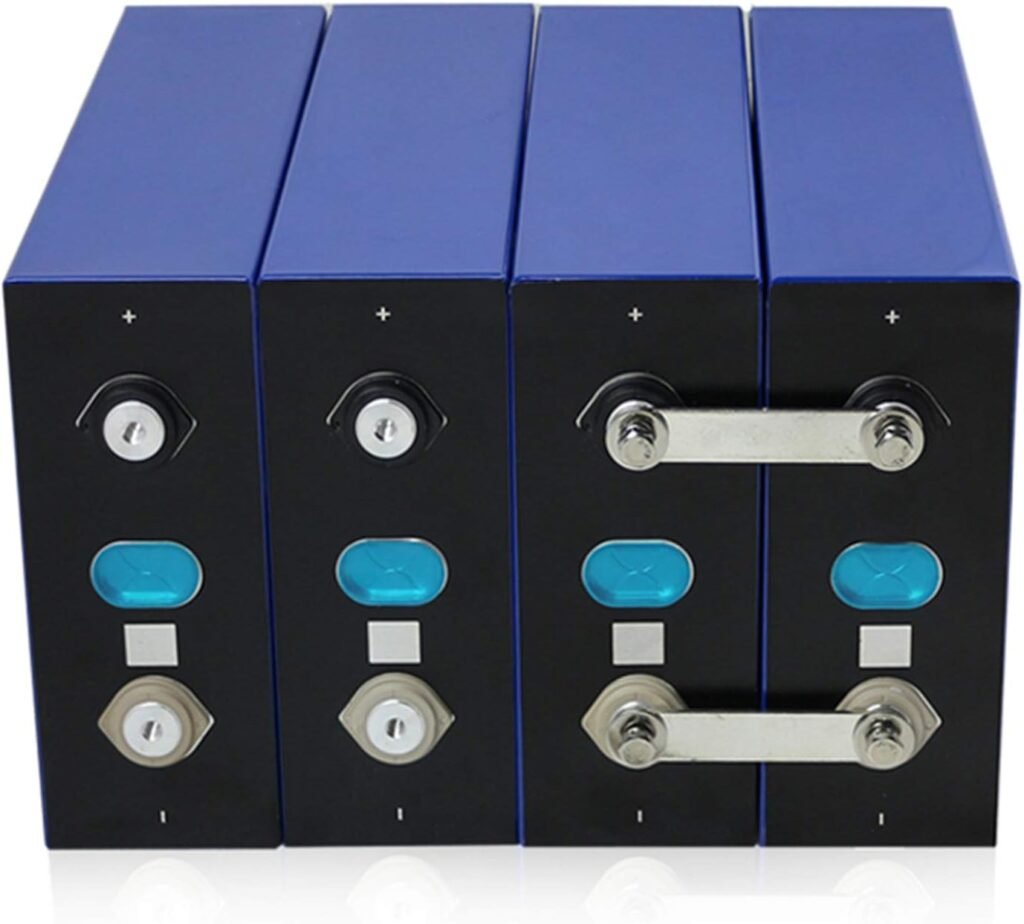
We notice these cells are reasonably compact given their 280Ah capacity, and at 5 kg apiece they’re easy for two people to move and mount. The provided screws, plugs, and bus bars simplify mechanical assembly, but we still recommend planning mounting brackets and spacing so the pack has room for wiring and airflow.

Electrical specifications and what they mean for us
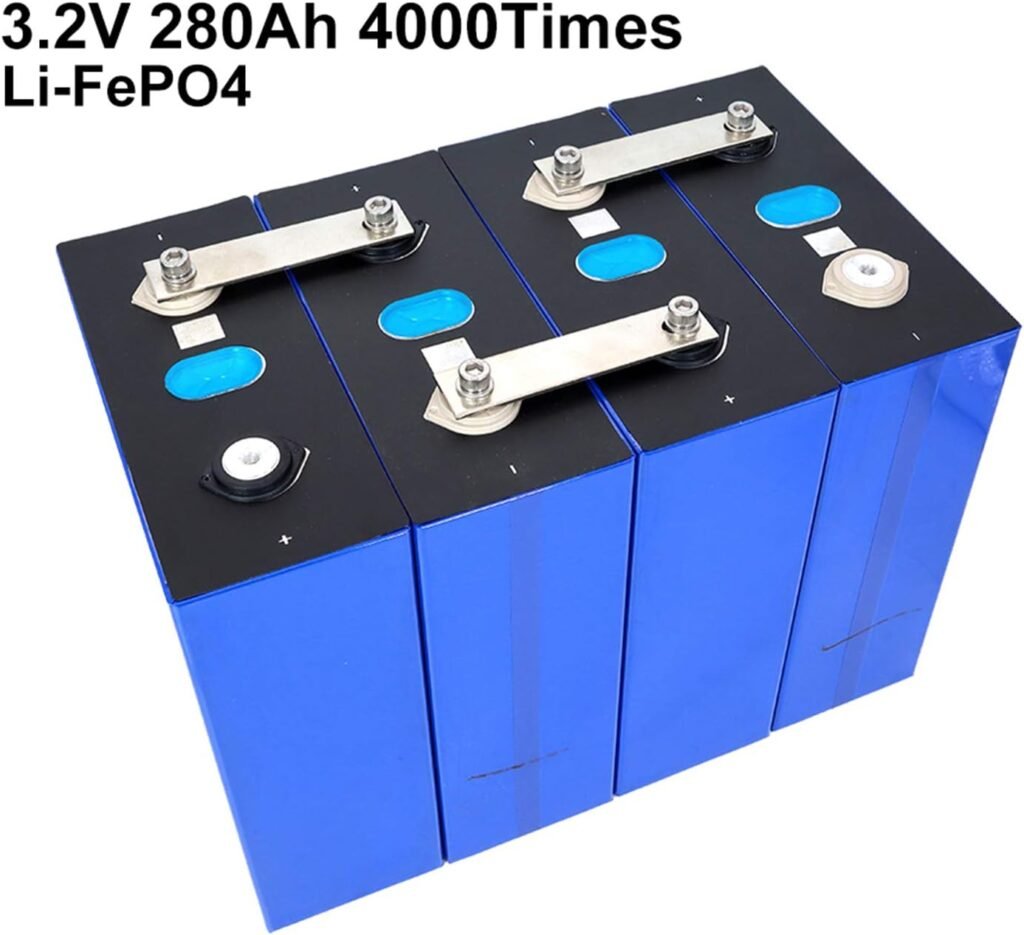
The nominal 3.2V per cell and 280Ah capacity mean a single cell contains roughly 896 Wh (3.2 V × 280 Ah). When we connect four in series we get around 12.8V nominal and about 3.6 kWh usable at 100% depth-of-discharge (which we typically avoid). Typical charging practice for LiFePO4 is to charge up to ~3.6–3.65V per cell (14.4–14.6V for a 4S pack), so we should configure our charger and inverter/charger accordingly.
Grade A performance and testing
We appreciate that the seller tests voltage and internal resistance before packaging and balances the cells for higher consistency. That pre-shipping quality control reduces the chance of getting a mismatched cell that would complicate building a multi-cell pack. For best results, we still measure the cells on receipt and log their open-circuit voltages and resistances.
Cycle life and service life expectations
The manufacturer states a typical estimated life of 5–15 years or 2000–8000 charge cycles. That wide range reflects differences in depth-of-discharge (DoD), charge/discharge rates, temperature, and how well we protect the pack with a proper BMS and charging regime. If we avoid frequent 100% DoD and keep charge/discharge current in reasonable limits, we can reasonably expect many thousands of cycles.
Real-world usable capacity and DOD recommendations
Even though the cell is rated 280Ah, we usually plan systems around an effective usable capacity to maximize longevity. For long life we tend to use 80–90% DoD in daily cycling (or configure charge cutoffs and inverter settings accordingly). That means per 280Ah cell, a practical usable capacity per cycle would be roughly 224–252 Ah; for a 4S bank that translates to about 2.9–3.2 kWh usable.
Building a 12V 280Ah pack: overview
Because these are 3.2V cells and the listing is a 4PCS kit, assembling a 4S pack to achieve a nominal 12.8V system is straightforward. The included bus bars and screws are intended to simplify the series connections. We still recommend using a quality BMS with appropriate voltage and current ratings, fusing, and secure mechanical mounting.
Series connection basics
We connect the positive of cell 1 to the negative of cell 2, the positive of cell 2 to the negative of cell 3, and the positive of cell 3 to the negative of cell 4, leaving the negative of cell 1 and the positive of cell 4 as the pack negative and pack positive respectively. The bus bars included usually cover these series links, but we always verify connections are tight and clean.
Suggested BMS and protections
We select a BMS rated for the continuous current we expect to pull and for the correct number of series cells (4S). The BMS should provide over-voltage, under-voltage, over-current, short-circuit protection, and ideally low-temperature charge cutoff. A BMS that supports cell balancing will help keep pack voltages consistent over time.
Installation and wiring tips
We like to be methodical when assembling packs so we reduce the chance of mistakes and make future maintenance easier.
- Lay out the cells on a non-conductive surface in the order they will be connected before fastening anything.
- Confirm each cell’s voltage and take a photo or record measurements for future reference.
- Use the supplied screws and plugs for the bus bars but add a thread locker if vibration is expected (e.g., in an RV).
- Tighten bus bar connections evenly and to the torque recommended by the bus bar or screw manufacturer; if no torque is provided, tighten to a snug, secure feel and then check after a controlled initial use period.
- Use insulated link covers or heat shrink on exposed bus bar connections to avoid accidental shorts.
- Mount the BMS and fuse near the pack positive terminal and keep wiring runs short to minimize resistance and heat.
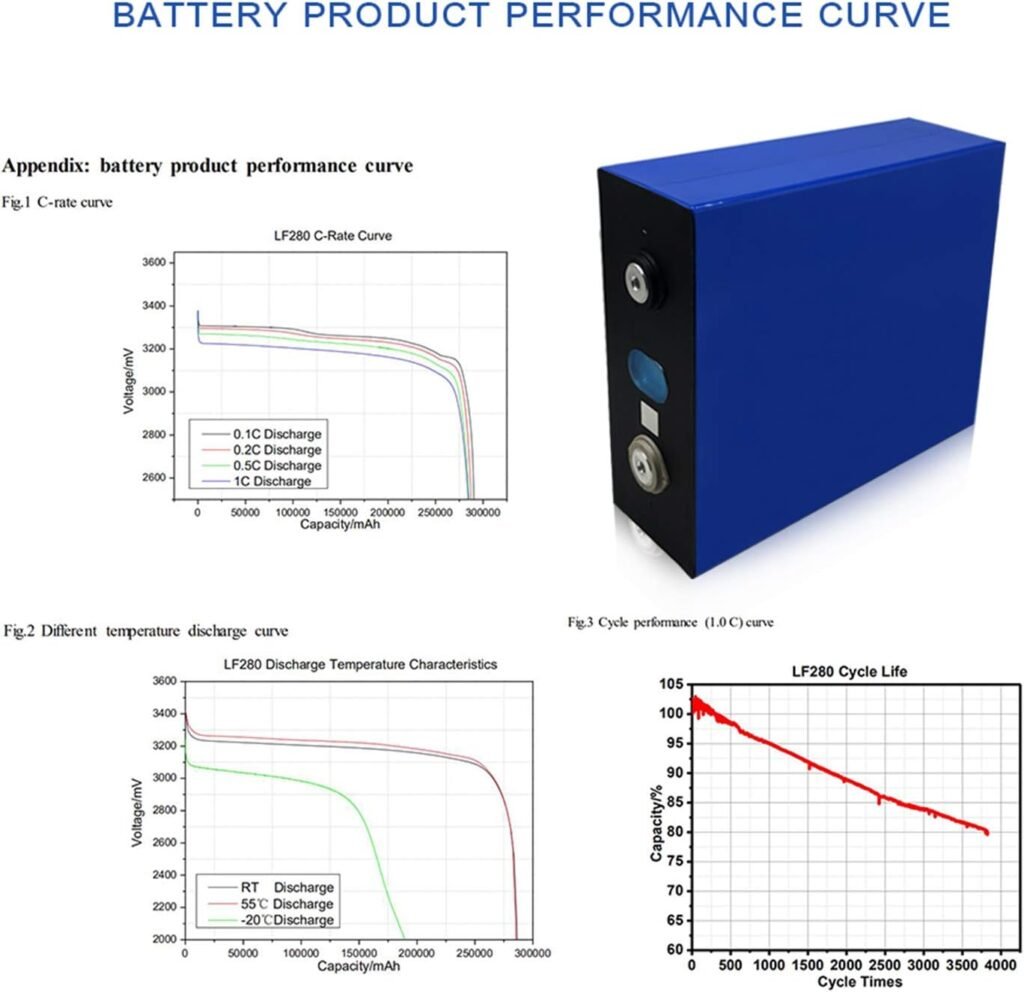
Table: Assembly checklist
The following table helps us ensure nothing important is missed during build and installation.
| Step | Action | Why it matters |
|---|---|---|
| 1 | Inspect and measure each cell (voltage, appearance) | Validate condition and record baseline |
| 2 | Arrange cells and position bus bars | Ensure proper series layout and spacing |
| 3 | Connect bus bars and tighten fasteners | Build series connections securely |
| 4 | Install BMS (connect each cell sense and pack +/-) | Over/under-voltage protection, balancing |
| 5 | Fit primary fuse/breaker near pack positive | Short-circuit protection |
| 6 | Insulate exposed metal and mount pack | Safety and vibration protection |
| 7 | Perform low-current initial charge and balance | Confirm wiring and BMS operation |
| 8 | Monitor temperatures and voltages during first cycles | Ensure no unexpected heating or imbalance |
Charging recommendations
Correct charging is critical to longevity and safety.
- Target per-cell full charge: approximately 3.6–3.65 V. For a 4S pack, set charger float/cutoff around 14.4–14.6 V.
- Recommended charge current: if the manufacturer does not specify a maximum C-rate, we adopt a conservative approach. For longevity we often use 0.1–0.3C for routine charging and up to 0.5C only when we know cells and BMS support it. For a 280Ah cell, 0.2C is 56A and 0.5C is 140A.
- Use a charger configured for LiFePO4 chemistry or an inverter/charger with a LiFePO4 charging profile. Avoid lead-acid profiles that float at higher voltages or require acceptance of different charge stages.
- Avoid charging at below-freezing temperatures unless the BMS provides low-temperature charge enable or the cells are warmed to safe charge range. Charging LiFePO4 below ~0°C can cause lithium plating and long-term damage.
BMS selection specifics
We recommend a BMS that matches these criteria:
- Supports 4 series cells (4S) and cell balancing.
- Continuous current rating at or above our expected system load plus safety margin (e.g., if we expect 100A continuous, pick a BMS rated for 120–150A).
- Peak/short-term current rating that handles inverter startup surges or motor inrush currents (if used with large inverters).
- Low-temperature charge cutoff and cell balancing thresholds configurable or matched to manufacturer specs.
- Good documentation and wiring diagrams for correct cell sense wiring.
Thermal behavior and environment
Understanding temperature limits helps us avoid premature aging or damage.
- Typical LiFePO4 charge temperature: 0°C to ~45°C (variations depend on cell design and BMS).
- Typical LiFePO4 discharge temperature: down to -20°C and up to ~60°C for some cells, but performance decreases near extremes.
- In practice we keep the pack in a moderate climate-controlled environment when possible, and avoid leaving packs in direct sun or near heat sources.
- For RVs, make space for thermal expansion and secure the pack against vibration; add an insulating or ventilated enclosure depending on climate extremes.
Safety considerations
We like LiFePO4 for its relative safety compared to other lithium chemistries, but batteries still require respect.
- Short circuits must be prevented: use proper insulation, bus bar covers, and a primary fuse on the pack positive terminal sized appropriately.
- Never rely solely on mechanical fasteners to hold bus bars; use lock washers or thread-locking compound where movement or vibration may occur.
- Keep tools insulated and avoid dropping metallic objects across terminals.
- Store and ship cells in their packaging or within protective containers, keeping them from heavy impacts or puncture risks.
- Handle cells as we would other high-capacity electrical energy sources — personal protective equipment and safe workspace practices are recommended.
Pros and cons (from our perspective)
We break these down so we can weigh choices quickly.
Pros
- High capacity (280Ah) in a compact form factor; good energy density per package size.
- Grade A performance with pre-shipping voltage and internal resistance testing improves pack consistency.
- Long expected cycle life if used with conservative charge/discharge settings.
- Includes bus bars, screws, and plugs to simplify series assembly for a 4S pack.
- LiFePO4 chemistry is thermally stable and safer than many other lithium types.
Cons
- The manufacturer’s maximum continuous current rating and C-rate aren’t explicitly stated in the listing (we recommend confirming before planning high-current applications).
- While bus bars are included, additional hardware (mounts, fuses, BMS, enclosures) is required to make a safe, finished battery system.
- Charging below-freezing conditions require special attention and possibly a BMS with low-temp charge protection.
Comparison with common alternatives
We like to compare to understand trade-offs.
- Versus lead-acid (flooded, AGM, GEL): LiFePO4 offers much longer cycle life, higher usable DoD, and lighter weight for similar usable energy. Upfront cost is higher but lifetime cost is lower.
- Versus NMC (lithium nickel manganese cobalt oxide): NMC often provides higher energy density but lower thermal and cycle stability than LiFePO4. LiFePO4 is a safer choice for stationary and mobile storage where longevity and safety matter.
- Versus other LiFePO4 cells from different vendors: Grade A testing and included hardware make this offering competitive; however, we still confirm C-rates and manufacturer warranty when comparing.
Real-world use cases and sizing examples
We think these cells fit multiple scenarios. Here are some typical setups we consider.
- Home solar energy storage: connecting four cells in series gives a 12.8V nominal, 280Ah pack (≈3.6 kWh nominal). For larger capacity we parallel additional 4S packs with care and an appropriate BMS or parallel management strategy.
- RV battery bank: 12.8V 280Ah is a strong single-bank option for moderate off-grid RV setups. With a 12V inverter, HVAC and heavy AC loads may require larger banks or paralleled packs.
- Backup power for small loads: This bank can easily run essential loads for several hours depending on consumption; using a conservative 80% usable capacity gives roughly 2.9 kWh usable which would run a 500W load for around 5–6 hours.
Step-by-step assembly example: 4 cells → 12.8V 280Ah pack
We give a practical sequence we use when assembling similar kits.
- Inspect shipment: check for dents, leaks, or physical damage and measure open-circuit voltage of each cell. Record results.
- Arrange cells in a stable layout with terminals accessible; ensure cell order is correct for series wiring.
- Attach bus bars following the series scheme (positive of one to negative of next). Use the included screws and plugs. Apply thread locker where vibration is likely.
- Fasten bus bars firmly but avoid over-torquing; recheck tightness after the first few charge/discharge cycles.
- Mount a 4S BMS and connect cell sense wires to each cell positive/negative per the BMS diagram. Double-check sense wire polarity and connections.
- Connect the pack positive to the inverter/charger through a suitably rated fuse or circuit breaker located as close as possible to the pack positive terminal.
- Conduct an initial slow charge at a modest current (e.g., 0.1C) while monitoring cell voltages and current to verify balance and BMS behavior.
- Run a controlled discharge test (e.g., 0.2C for an hour) while monitoring temperatures and voltages.
- If everything behaves normally, complete mounting, add insulating covers to bus bars, and finalize cable routing.
Maintenance and care tips
We keep our battery packs healthy with a few routine practices.
- Log voltages and states during initial commissioning and again after the first several dozen cycles.
- Avoid sustained operation at extremes of temperature or at very high continuous currents unless the pack is rated for it.
- Keep the BMS firmware (if updatable) and charger firmware current where applicable.
- Periodically check terminal tightness and look for discoloration or heat signs near connections.
- Balance periodically if the BMS does not actively balance during normal charging; many modern BMSs balance during regular charging cycles.
Troubleshooting common issues
We list common symptoms and our usual checks.
- Symptom: Pack imbalance (one cell voltage much higher or lower) — Check BMS sense wiring, balance function; perform a controlled balance charge/discharge under supervision.
- Symptom: Unexpected capacity loss — Verify charge/discharge current history, operating temperatures, and BMS cutoffs. Re-check internal resistance values.
- Symptom: Abnormal heating — Check for loose connections, short circuits, or high continuous current; measure terminal and bus bar temperatures and correct wiring if needed.
Frequently asked questions (brief)
Q: Can we connect these cells in parallel to increase capacity? A: Yes — parallel strings of identical 4S packs can increase capacity (Ah). We ensure all packs are matched, at similar voltage and state-of-charge when paralleling, and that the BMS strategy supports parallel configuration.
Q: What charger voltage should we use for a 4S pack? A: We set the charger to around 14.4–14.6 V for a 4S LiFePO4 pack (3.6–3.65 V/cell). Use a LiFePO4-compatible profile and follow the BMS guidance.
Q: Is a professional installer required? A: For people experienced with battery systems, the kit is assemble-able. For high-current installations, complex parallel packs, or where code compliance matters, we recommend consulting or hiring a qualified electrician or battery technician.
Q: Do we need to pre-balance cells on arrival? A: Even though the seller balances cells before shipping, we measure and, if slight differences exist, perform a controlled charge or use a balancing device to bring voltages as close as possible before final assembly.
What we like about the package deal
We appreciate that the product includes bus bars and mounting hardware, which accelerates assembly and reduces the need to source separate connectors. The Grade A performance claim and pre-packaging testing give confidence, and the compact dimensions make it relatively simple to integrate into cabinets, RV battery compartments, or custom enclosures.
What we’d confirm before purchasing
We recommend verifying a few points with the seller or datasheet prior to placing a large order or designing a high-current system:
- Maximum recommended continuous discharge and recommended peak (C-rate) for the cell.
- Manufacturer-recommended charge current and exact charge cutoff voltage.
- Warranty terms and support for replacements or cells that fail early.
- Compatibility notes for paralleling packs and any recommended balancing procedure.
Final thoughts and recommendation
Overall, we find the LiFePO4 3.2V 280Ah Cells for 12V 280Ah Home Solar Energy Storage System RV Battery with Bus Bars 4PCS/LOT attractive for DIYers and installers looking to build a 12.8V 280Ah bank. The Grade A testing, included bus bars and hardware, and the solid lifespan expectations of LiFePO4 chemistry make these cells a practical choice for residential solar, RV, and backup applications. We encourage careful planning around BMS selection, charging profiles, and physical mounting to get the most reliable and long-lived performance from the pack.
If we move forward with these cells, our next steps would be to confirm the maximum continuous current rating with the seller, select a BMS sized with a comfortable margin above our expected loads, and design a pack enclosure with proper mounting, insulation, and ventilation for our intended environment.
Disclosure: As an Amazon Associate, I earn from qualifying purchases.