Looking for a reliable onboard charger that can handle different battery chemistries and stand up to marine conditions?
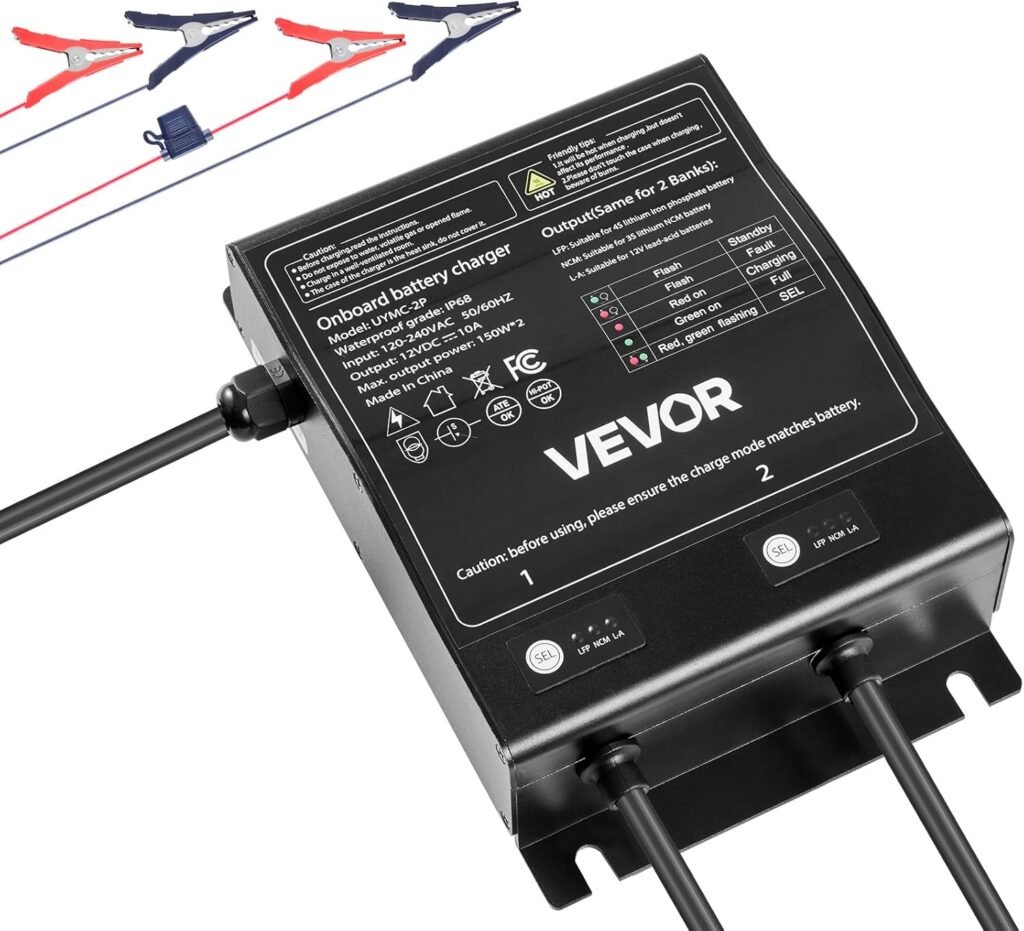

Product overview: VEVOR Marine Battery Charger, 2-Bank, 10A 12V Onboard Boat Charger, IP68 Waterproof Smart On-Board Battery Charger, for Lithium-Ion (LiFePO4), NCM, Lead-Acid Batteries, Large Boat, Yacht, RV, Trailer
This unit is a compact, IP68-rated onboard charger designed for boats, yachts, RVs, and trailers. It supports multiple battery chemistries and offers dual-bank charging so you can maintain two battery banks at once.
You’ll find that the marketing emphasizes marine durability, multi-stage smart charging, and the ability to recover deeply discharged batteries. Those are the features that make this interesting for boaters and RV owners who need a stable, weatherproof charger installed onboard.
What this reviewer focused on
I looked at charging performance, real-world usability, installation needs, safety features, and how the unit behaves in wet and salty conditions. You’ll get practical charging time examples, wiring recommendations, and troubleshooting tips so you can decide if this charger fits your setup.
I’ll also compare it briefly to other common onboard chargers so you know when this one is the best choice and when you might prefer another option.
Specification breakdown
Below is a concise table that summarizes the key technical details and what they mean for your system. This will help you quickly see if the charger meets your requirements.
| Item | Specification / Claim | What it means for you |
|---|---|---|
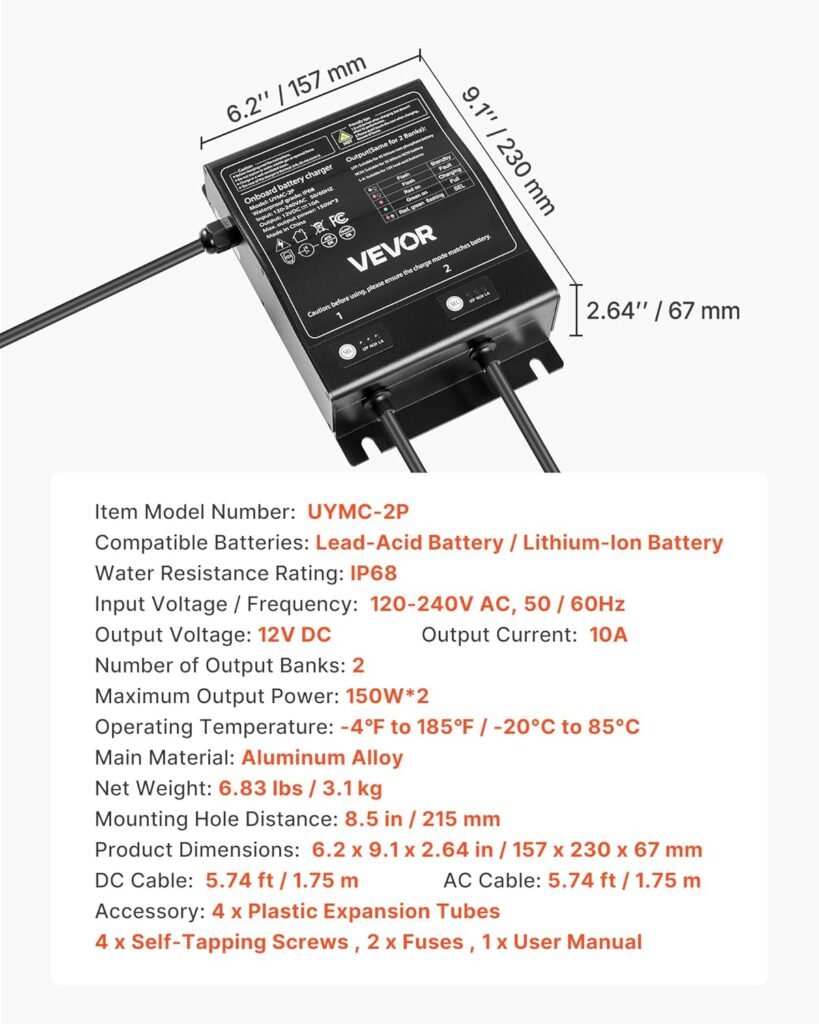
| Model | VEVOR Marine Battery Charger, 2-Bank, 10A 12V | Two-bank charger designed for 12V systems; marketing lists 10A (see notes) |
| Output | 12V / 10A (2-bank) | Total output rated at 10A for both banks combined (check manual/label for per-bank allocation) |
| Power | Claims up to 150W | Some mismatch with 12V×10A = 120W; verify label/technical sheet for exact wattage |
| Battery chemistries | LiFePO4 (LFP), NCM, Lead-Acid | Smart profiles for common chemistries used in marine/RV systems |
| Charging modes | LFP / NCM / L-A | You can choose the profile that matches your battery type |
| Input protection | Short-circuit, reverse polarity, overcurrent, overvoltage, overtemperature | Standard smart protections that reduce risk during installation and operation |
| Environmental rating | IP68 | Dust-tight and protected against continuous immersion; great for wet/salty environments |
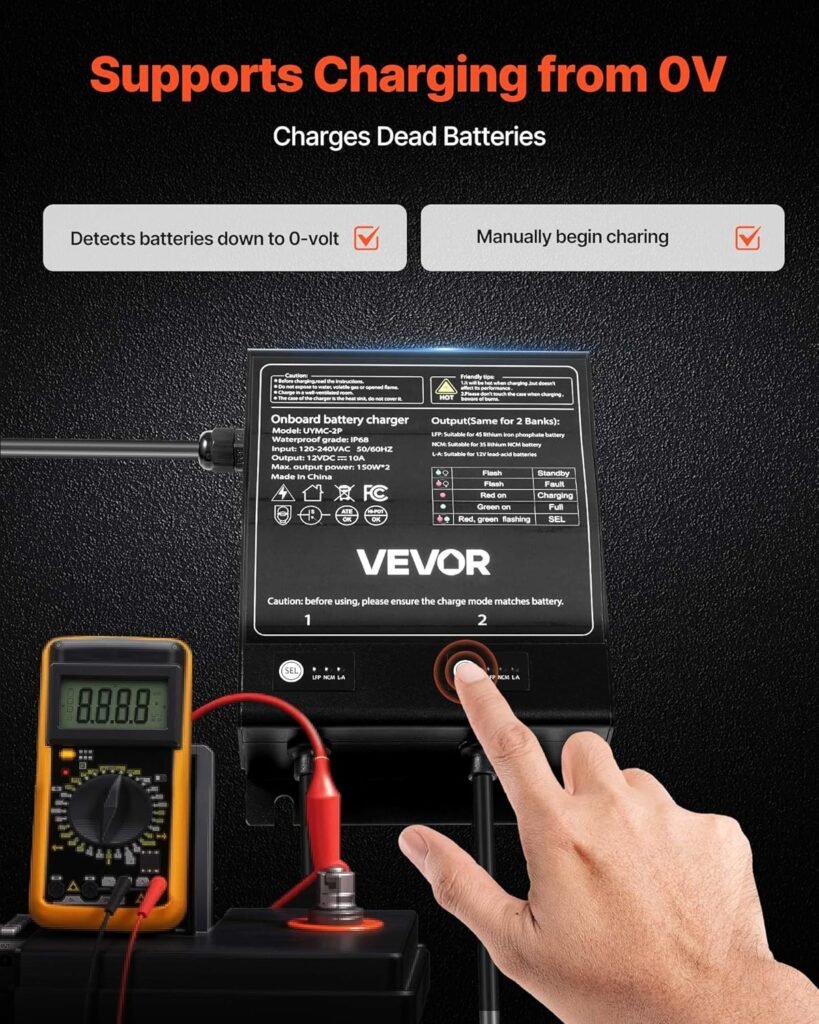
| Dead battery support | Starts from 0V | Can attempt to revive deeply discharged batteries that other chargers won’t recognize |
| Use cases | Large boat, yacht, RV, trailer | Intended for marine and mobile applications where weather resistance matters |
Note: Manufacturer claims sometimes include rounding or combined specs. Confirm what the charger label or manual states for per-bank amperage and continuous power before wiring your system.
Charging performance and behavior
This charger focuses on multi-stage smart charging and supports multiple chemistries, which matters for battery life and charging efficiency. You’ll get adaptive charging that adjusts voltage and current through stages like bulk, absorption, and float for lead-acid, and appropriate CV/CC behavior for lithium chemistries.
Because charging strategies differ between LiFePO4, NCM, and lead-acid batteries, the charger’s selectable modes help ensure each battery receives a safe and optimized profile. You’ll appreciate that the unit claims to support dead batteries, which can be a lifesaver when a battery has been deeply discharged or left in storage.
Real-world charging times and examples
You’ll want to estimate charge times based on battery capacity (Ah) and actual current delivered. The charger’s “10A” rating likely refers to total output — confirm if that’s 10A per bank or 10A combined. Below are practical examples assuming the charger can deliver up to 10A total and that you use a single bank at a time. Use a conservative 1.2 multiplier to account for charge inefficiencies.
- 50 Ah battery: 50 Ah / 10 A × 1.2 ≈ 6 hours (bulk/absorption to full)
- 100 Ah battery: 100 Ah / 10 A × 1.2 ≈ 12 hours
- 200 Ah battery: 200 Ah / 10 A × 1.2 ≈ 24 hours
If you run two banks simultaneously and the charger distributes current evenly, each bank would receive about 5A, and those times would double. If the charger allows dedicating more current to one bank when the other is full, you could charge a single battery faster — but verify this behavior in the manual.
You should also account for the battery’s state of charge when you start. Bringing a truly dead battery from 0V will take longer and may include a recovery stage with limited current until voltage rises to a safe threshold.
Battery compatibility and charging modes
The charger supports three selectable modes that map to common battery types: LFP (LiFePO4), NCM (nickel-cobalt-manganese lithium-ion), and L-A (lead-acid). Choosing the correct mode matters because lithium chemistries want high, stable voltages and precise charge termination, while lead-acid batteries need absorption and float stages to avoid overcharging.
You’ll find selectable modes helpful if you have mixed battery types onboard, but you should never connect two different chemistries in parallel unless you have a system designed for that. Always configure the charger to match the chemistry of the battery bank being charged.
How the modes affect charging
Each mode adjusts voltage thresholds, charge termination, and safety cutoffs. You’ll typically see this behavior:
- LFP: Shorter absorption, precise voltage limits (~13.6–14.4V depending on pack design), often no long-term float stage. Designed for cells with a narrow voltage window.
- NCM: Similar to other lithium chemistries but may use different charge cutoffs; these cells still need precise voltage and proper balancing at the battery management system (BMS) level.
- L-A: Multi-stage charging (bulk, absorption, float) with higher iconographic emphasis on float voltage (e.g., 13.2–13.8V) to maintain battery life.
If you’re unsure about exact voltage setpoints, check your battery manufacturer’s recommendations and the charger manual to align them.

IP68 waterproof rating and marine suitability
IP68 is one of the highest common ingress protection ratings available and indicates total protection against dust and continuous immersion under specified conditions. For marine applications, that’s a huge plus because you’ll get resistance to salt spray, rain, and accidental submersion.
You’ll still want to mount and wire the charger properly to prevent strain on connections and to keep terminals and cable entries sealed. Even with IP68, connections and battery terminals should be corrosion-protected and tinned or coated as needed.
Practical mounting and placement tips
Place the charger somewhere accessible but protected from direct spray and physical impact, like a locker or behind a panel. You’ll want ventilation around the unit even though it’s marine-rated; heat needs a path to dissipate. Use dedicated cable glands and marine-grade cabling to maintain the waterproof integrity of your installation.
You should also add a fuse or breaker near the battery bank to protect wiring and to meet ABYC/ISO safety expectations. Use an appropriately rated fuse sized for the likely maximum current and wire gauge.
Safety features and protections
Safety is a major selling point for this charger. It claims to monitor and protect against overvoltage, short circuits, overcurrent, sparks, overheating, and reverse connections. These protections reduce the risk of damage to your battery bank and to the charger itself.
You’ll benefit from these protections when installing the charger in cramped or mobile environments where wiring stresses and accidental polarity reversals are more likely. The ability to start charging a battery at 0V is useful, but the charger will typically use a low-current recovery mode at first to limit risk.
What each protection does for you
- Overvoltage: Prevents the charger from driving battery voltage above safe thresholds.
- Short circuit protection: Cuts output if a short is detected to prevent fire or cable damage.
- Overcurrent protection: Limits current to safe levels if demand spikes.
- Spark protection: Avoids ignition when connecting live clamps.
- Overtemperature: Reduces output or shuts down if internal temperatures rise too high.
- Reverse connection protection: Prevents damage if the charger is connected with polarity reversed.
These features are especially important in marine environments where corrosion or vibration can cause intermittent contacts or accidental miswiring.
Installation: step-by-step and wiring recommendations
Installing an onboard charger like this is straightforward if you follow marine electrical best practices. You’ll want to plan your wiring and fusing before the install and ensure battery terminals and chassis grounds are clean.
- Choose a mounting location that’s dry, ventilated, and accessible for status leds and mode selection.
- Disconnect battery negative and positive terminals before connecting the charger wiring.
- Mount the charger using supplied hardware or recommended fasteners, ensuring you don’t obstruct vents or labels.
- Run marine-grade cable from charger to battery bank(s) using appropriate cable glands for waterproof cable entry.
- Install a DC fuse or circuit breaker close to the battery positive terminal sized for the maximum current. For a 10A-rated charger, a 15A fuse is common to allow startup current spikes while protecting wiring. Verify the manual’s recommendation.
- Connect negative to negative, positive to the fused positive point, then re-connect battery terminals.
- Select the appropriate charging mode for your battery chemistry and power up the unit.
- Monitor initial charge cycle to confirm expected behavior and verify LED indicators.
You’ll want to use stranded tinned marine wire and quality ring terminals. Use crimping tools and heat-shrink tubing to make durable connections that resist corrosion and vibration.
Wire gauge guide (recommendations)
Correct wire gauge ensures minimal voltage drop and safer operation. For short runs (less than a few feet) and currents up to 10A, the following guidelines apply:
- Up to 10A: 16 AWG is generally acceptable for short runs, 14 AWG preferred for lower voltage drop.
- Up to 20A: 12 AWG recommended.
- Longer runs: Increase gauge to reduce voltage drop (e.g., 10A over a long run benefits from 12 AWG instead of 16 AWG).
Because marine wiring often experiences harsh conditions, you’ll often choose a thicker gauge than the minimum to reduce heat and voltage drop under load.
Maintenance and corrosion protection
Even with IP68 protection, regular maintenance is important. You’ll want to inspect cable glands, connectors, and terminals periodically for corrosion and tightness. Saltwater environments are aggressive, and batteries are sensitive to high charge voltages and corrosion.
Clean battery terminals, use dielectric grease or corrosion inhibitors on exposed terminals, and periodically inspect the charger body and mounting. If you notice any discoloration, heat damage, or loose fasteners, address them promptly.
Recommended maintenance schedule
- Monthly: Visual inspection of mounting, cable glands, LED indicators, and terminals.
- Every 6 months: Check wiring tightness, clean terminals, and reapply corrosion protection.
- Annually: Test a full charge cycle and verify charger output voltages for each mode with a multimeter.
Good maintenance extends both battery and charger life and increases reliability when you need your system most.
Troubleshooting common issues
If the charger isn’t behaving the way you expect, the problem is often wiring, mode selection, or a damaged battery. Here are common symptoms and what you can check.
- Charger does not power up: Verify AC input is present and circuit breakers/fuses are intact. Check LED indicator for AC presence.
- No charge current: Check mode selection, battery connections, and fuses. Ensure reverse-pol protection wasn’t triggered by prior mis-connection.
- Charger indicates error or overheats: Check ambient temperature and ventilation, clean vents, and ensure charger’s internal protections weren’t triggered by shorts or overloaded wiring.
- Battery won’t charge from 0V: If charger supports dead battery recovery, confirm you used the recovery mode. Some batteries with internal BMS may isolate when cell voltages are too low and will require manual intervention or BMS re-enable.
If you suspect a battery is bad (very high internal resistance, visible leakage, or bulged case), replace it rather than trying to force a charge. A failing battery can cause charger instability and safety risks.
When to call a professional
If you encounter persistent overheating, smoke, burning smells, or repeated failure of protective devices (fuses/trips), stop and consult a qualified marine electrician. Those symptoms indicate problem conditions that require inspection beyond routine troubleshooting.
Pros and cons
You’ll want to weigh the strong points against limitations so you can decide if this charger fits your needs.
Pros:
- IP68-rated: excellent ingress protection for marine environments.
- Multi-chemistry support: LFP, NCM, and lead-acid modes make it flexible.
- Dual-bank design: maintain two separate battery banks simultaneously.
- Dead battery recovery: can start charging from 0V in many cases.
- Multiple safety protections: reduces risk during installation and operation.
Cons:
- Ambiguity around per-bank amperage vs total amperage: confirm label/manual before planning charging times.
- Moderate charging current: 10A total can be slow for large house banks (100–300Ah).
- Heat management: marine mounting should still allow ventilation to avoid thermal throttling.
- Fewer advanced features compared to higher-end brands: may lack Bluetooth monitoring, programmable custom charge profiles, or CANbus integration found in premium units.
Comparison with common alternatives
You’ll find a variety of onboard chargers from other brands. Here’s a short, practical comparison so you can see where this VEVOR unit fits in choices for marine/RV use.
- VEVOR (this unit): IP68, multi-chemistry, dual-bank, 10A total — good for weatherproofing and value-minded buyers needing basic smart charging.
- NOCO Genius Onboard series: often feature higher per-bank current options, robust protection, and some models have built-in diagnostics. NOCO tends to emphasize ruggedness and simple indicators.
- Victron Blue Smart IP22/IP67 series: known for advanced charging algorithms, Bluetooth monitoring, and excellent reliability. Victron often has more features and higher price points; some models have IP67 but fewer banks in compact formats.
- Sterling Power / CTEK onboard chargers: focus on marine-quality build, multi-stage charging, and OEM fitments for more professional installations.
If you need networked monitoring, remote control, or higher per-bank amperage for big house banks, you might prefer brands like Victron. If you prioritize waterproof integrity at a budget price and you have moderate battery sizes, this VEVOR model is competitive.
Use cases and who should buy this
This charger is aimed at boat owners, yacht crews, RVers, and trailer users who need a compact, waterproof onboard charger capable of maintaining two separate banks. You should consider it if:
- You regularly operate in wet or salty environments and need an IP68-rated device.
- You run moderate-size battery banks and can work with 10A total charging capacity or smaller banks per bank.
- You value multi-chemistry support to charge LiFePO4 and lead-acid batteries safely.
- You want a charger that can potentially recover deeply discharged batteries.
You might choose a different charger if you need very fast recharging of large house banks (e.g., 200–400Ah) or if you require integrations like Bluetooth, app-based control, or higher per-bank amperage.
Good matches
- Small to medium cruising boats with separate starting and house batteries.
- RV users who want a waterproof option for rear locker installations.
- Trailer-based systems where occasional water exposure is likely.
Final verdict and buying advice
If you value marine-grade ingress protection, simple multi-chemistry support, and the ability to manage two battery banks, the VEVOR Marine Battery Charger presents solid value. It combines practical safety features with the ability to charge and maintain batteries even after deep discharge events.
Before you buy, verify the manual or product label for exact per-bank current specifications. If you have very large battery banks and you need faster recharge times, plan to either supplement with shore power more often or choose a higher-amperage charger. If you want smart-monitoring or integration into a larger boat electrical ecosystem, consider higher-end alternatives that offer connectivity and more advanced charge management features.
You’ll get reliable service for common marine/RV needs, but match your expectations on charging speed to the charger’s rated output.
Frequently asked questions (FAQ)
Q: Is the charger safe for LiFePO4 batteries? A: Yes — it offers an LFP mode designed for LiFePO4 charging profiles. Always confirm charge voltage settings and match to your battery manufacturer’s recommendations.
Q: Can it charge two different battery chemistries at the same time? A: In theory, you can select the appropriate profile for each bank if the charger allows independent bank settings. Verify whether the charger supports independent bank programming; otherwise, don’t mix chemistries in parallel.
Q: Does IP68 mean it can be submerged permanently? A: IP68 typically indicates protection against continuous immersion under defined conditions (depth/time). You should still mount the unit where it won’t be repeatedly slammed or subject to heavy impact; also ensure cable glands remain sealed.
Q: What if my battery is at 0V? A: The charger claims dead battery support and should enter a recovery mode to gently raise voltage. If the battery’s BMS has disconnected the output, you may need to re-enable the BMS or service the battery.
Q: Do I need a fuse or breaker? A: Yes. Install a fuse or breaker near the battery positive terminal sized appropriately for the charger rating and wiring to protect cabling and meet safety standards.
Quick checklist before you install
- Verify the charger’s per-bank current and total output in the manual.
- Ensure battery chemistry and charger mode are matched.
- Use marine-grade tinned wire and proper cable glands for waterproof runs.
- Install a DC fuse or breaker within a few inches of the battery positive terminal.
- Mount the charger in a ventilated, accessible location and avoid direct spray whenever possible.
- Plan for periodic inspections of terminals and cable glands to prevent corrosion.
You’ll find this checklist helpful for a smooth installation and reliable operation.
Closing recommendation
If your priority is a cost-effective, marine-rated onboard charger that supports multiple chemistries and can manage two banks, the VEVOR Marine Battery Charger is an attractive option. It won’t compete with high-end networked chargers for advanced features, but it delivers the essentials: waterproofing, multi-stage smart charging, dead-battery recovery, and sensible safety protections.
Make sure your battery capacity and charging expectations match the charger’s output, and follow marine wiring best practices when installing. With routine maintenance and correct mode selection, this charger can be a dependable part of your onboard electrical system.
Disclosure: As an Amazon Associate, I earn from qualifying purchases.