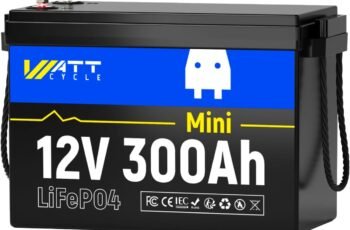
We find this 12.8V 300Ah LiFePO4 leisure battery offers 3,840Wh of energy and 150A continuous discharge, making it suitable for off-grid and backup systems. It requires a compatible charger rated up to 14.6V, and charging below 0°C isn’t permitted. Its large 522 × 240mm footprint and 250mm terminal height may complicate installation. Before buying, we’d verify inverter compatibility and confirm the warranty, since descriptions conflict. We’ll cover its specifications, key trade-offs, and purchase checks next.
Key Takeaways
- The 12.8V, 300Ah battery provides 3,840Wh of capacity for off-grid, leisure, and backup power.
- It supports 150A continuous discharge, with a stated 600A peak, and has a 10.0V discharge cut-off.
- Use a LiFePO4-compatible charger set to a maximum of 14.6V; charging below 0°C is not permitted.
- Its built-in BMS provides overcharge, overdischarge, overcurrent, short-circuit, and high-temperature protection.
- Check installation space, inverter and charger compatibility, and warranty terms, which are inconsistently stated as five or eight years.
12.8V 300Ah Battery Specs
The 12.8V 300Ah LiFePO4 battery stores 3,840Wh and weighs 70% less than a comparable lead-acid battery. We can assess its capacity and voltage against your system’s needs: its rated output is 12.8V, with a 10.0V discharge cut-off.
For charging requirements, use a LiFePO4-compatible charger set to no more than 14.6V; the charger isn’t included. The preferred minimum charging current is 60A, while maximum charging current reaches 300A.
Continuous discharge is rated at 150A, with a 600A peak. These figures help us evaluate energy storage, charging compatibility, and load support before choosing the battery for an application.
Detailed features
Beyond its electrical ratings, this battery combines built-in BMS protection with flexible system expansion. The BMS monitors overcharge, overdischarge, overcurrent, short circuits, and high temperatures, while thermal management supports operation within specified limits: charging from 0–55°C and discharging from −20–60°C.
For charging compatibility, use a LiFePO4 charger capped at 14.6V; a charger isn’t included. We can connect up to four units in series or parallel. Before series connection, match battery voltages within 0.1V.
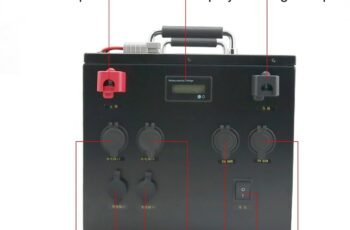
The maintenance-free design uses two M8 terminals and measures 522 × 240 × 218mm, or 250mm high including terminals, aiding installation planning in confined spaces.
Pros and Cons
We’ll assess the battery’s advantages, including its 3,840Wh capacity, built-in protections, and low weight. We’ll also consider limitations such as its size, charging requirements, and unclear warranty term.
This comparison will help you judge its suitability for your setup.
Pros
Although its 3,840Wh capacity suits substantial off-grid and backup loads, this battery’s strongest advantages are its built-in BMS, maintenance-free design, and flexible expansion: you can connect up to four units in series or parallel.
| Advantage | Specification | Practical value |
|---|---|---|
| Long lifespan | Up to 10 times lead-acid life | Fewer replacements |
| Lightweight design | 70% lighter than lead-acid | Easier handling |
| BMS protection | Monitors key electrical and thermal risks | Safer operation |
We can also value its 150A continuous discharge rating for substantial loads. The 600A peak supports brief surges, while 3,840Wh provides useful stored energy. For system planning, match voltages within 0.1V before series connections. Together, these features make it a capable, adaptable choice for leisure and backup systems.
Cons
Despite its 3,840Wh capacity, this battery has practical limits: its 70kg-class form factor and 522 × 240 × 218mm dimensions can make installation difficult, and the 250mm height with terminals requires extra clearance.
High upfront cost may also deter buyers, even with the stated long lifespan; we should verify warranty terms, since the listing gives both five- and eight-year descriptions.
Limited cold charging is another constraint: charging is permitted only from 0°C, so winter use may require temperature management.
The charger isn’t included, and we must select a LiFePO4-compatible model capped at 14.6V to avoid damage or safety risks.
Concluding thoughts
Overall, this 12.8V 300Ah LiFePO4 battery offers 3,840Wh of rated energy, a built-in BMS, and expansion support for up to four batteries in series or parallel, making it a versatile option for off-grid and backup systems. Its 150A continuous discharge rating suits many loads, while the 600A peak rating supports brief surges.
We’d check your inverter’s requirements, available space, and charging setup before buying; the charger isn’t included, and charging must stay within 14.6V. For real world suitability, confirm capacity and temperature limits match your use. A stated 5,000-cycle warranty and maintenance-free design may strengthen long term value, though warranty terms need clarification.
Frequently Asked Questions
Can This Battery Power a 12V Refrigerator Overnight?
Yes, we can power a 12V refrigerator overnight: 3,840Wh nominal capacity provides substantial energy, though usable runtime depends on refrigerator energy consumption, compressor cycling, temperature, and conversion losses. Check its daily watt-hours to estimate Overnight fridge runtime accurately.
What Charger Should I Use With This Battery?
Use a dedicated LiFePO4 charger rated for 12.8V batteries. We recommend checking LiFePO4 charger compatibility and charging voltage limits: set the cutoff to 14.6V maximum, and keep charging current between 60A and 300A.
Can I Install the Battery Inside a Camper?
Yes, we can install it inside a camper, provided we secure it and follow Indoor installation and ventilation requirements. Keep it within its operating temperature range, protect terminals, and use a compatible LiFePO4 charger.
How Should I Store the Battery When Unused?
Store it cool, dry, and disconnected; batteries, unlike houseplants, don’t thrive on neglect. Keep Storage temperature within 0–55°C, maintain a moderate charge level, and check periodically. We’d use a LiFePO4-compatible charger before storage.
Can This Battery Power an Inverter for Household Appliances?
Yes, we can power an inverter, provided its input matches 12.8V and continuous draw stays within 150A. For Inverter sizing, allow for startup surges; Appliance runtime depends on load, conversion losses, and usable capacity.
Conclusion
We see the 12.8V 300Ah battery as a substantial option for solar storage, camping, or backup, with 3,840Wh of rated capacity and a 150A continuous output. Its weight advantage and built-in protection are appealing, but we’d verify dimensions, temperature limits, and compatibility before installation. Budget for a suitable 14.6V LiFePO4 charger, and check the preferred 60A charging current. Clarify the warranty terms, too: five years or 5,000 cycles and eight years aren’t the same promise. Choose with your setup in mind.