Are you trying to safely charge a LiFePO4 house battery from your vehicle or boat while keeping things waterproof and straightforward?
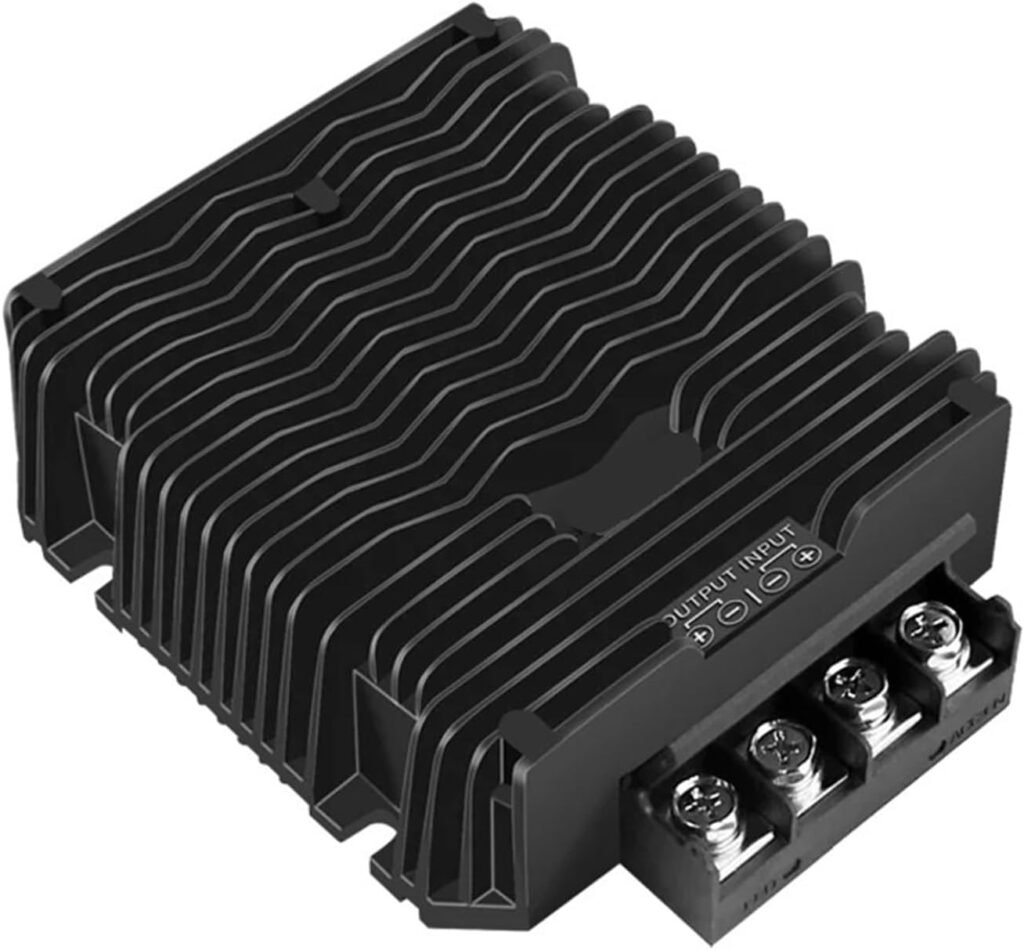

First impressions of the Waterproof 12V to 29.2V 43.8V 58.4V 10A 20A DC/DC Lifepo4 Lithium Battery Charger for 24V 48V RVs Boat Dual Battery System(DC29.2V 20A_WITH ACC WIRE)
When you unpack this unit, you’ll notice it’s heavy enough to feel solid and compact enough to fit into many tight spaces. The long product name tells you the essentials: it’s a DC-to-DC charger that can step voltages for several LiFePO4 battery bank voltages, comes in 10A and 20A outputs, and includes an ACC (accessory/ignition) wire for smart charging control.
What you should expect from the product name
The name indicates multiple output voltage options (29.2V, 43.8V, 58.4V) that match common LiFePO4 battery pack configurations and two current ratings (10A and 20A). The ACC wire suffix signals that the charger can be turned on/off with your vehicle’s ignition so charging happens when the alternator is running.
Key specifications and what they mean for you
Below is a compact breakdown of the core specifications and what they imply for daily use. This helps you match the charger to the battery configuration you own or plan to install.
| Parameter | What the spec is | What it means for you |
|---|---|---|
| Input | 12V nominal vehicle/alternator system | Designed to run from a 12V source like a car, truck, or boat; can accept typical alternator voltage ranges |
| Output voltages | 29.2V, 43.8V, 58.4V | Matches 8s, 12s, and 16s LiFePO4 battery packs (3.65V/cell charge) used in 24V and 48V systems |
| Output current | 10A or 20A versions | Provides modest charging power; 20A is suitable for faster charging of mid-size house batteries |
| Form factor | Waterproof DC-DC charger | Intended for damp or marine environments where some water protection is required |
| ACC wire | Included on model DC29.2V 20A_WITH ACC WIRE | Allows automatic enable/disable with ignition or other control circuit |
| Application | RVs, boats, dual battery systems | Made for charging a secondary battery bank while the engine is running |
How the specs translate to performance
These specs mean the device will convert alternator voltage to the correct LiFePO4 charging voltage with a regulated current limit. If you’re running a 24V or 48V house bank made from LiFePO4 cells, the charger will supply a controlled charge without relying on the alternator to directly supply the higher pack voltage.
What’s in the box and what you should check first
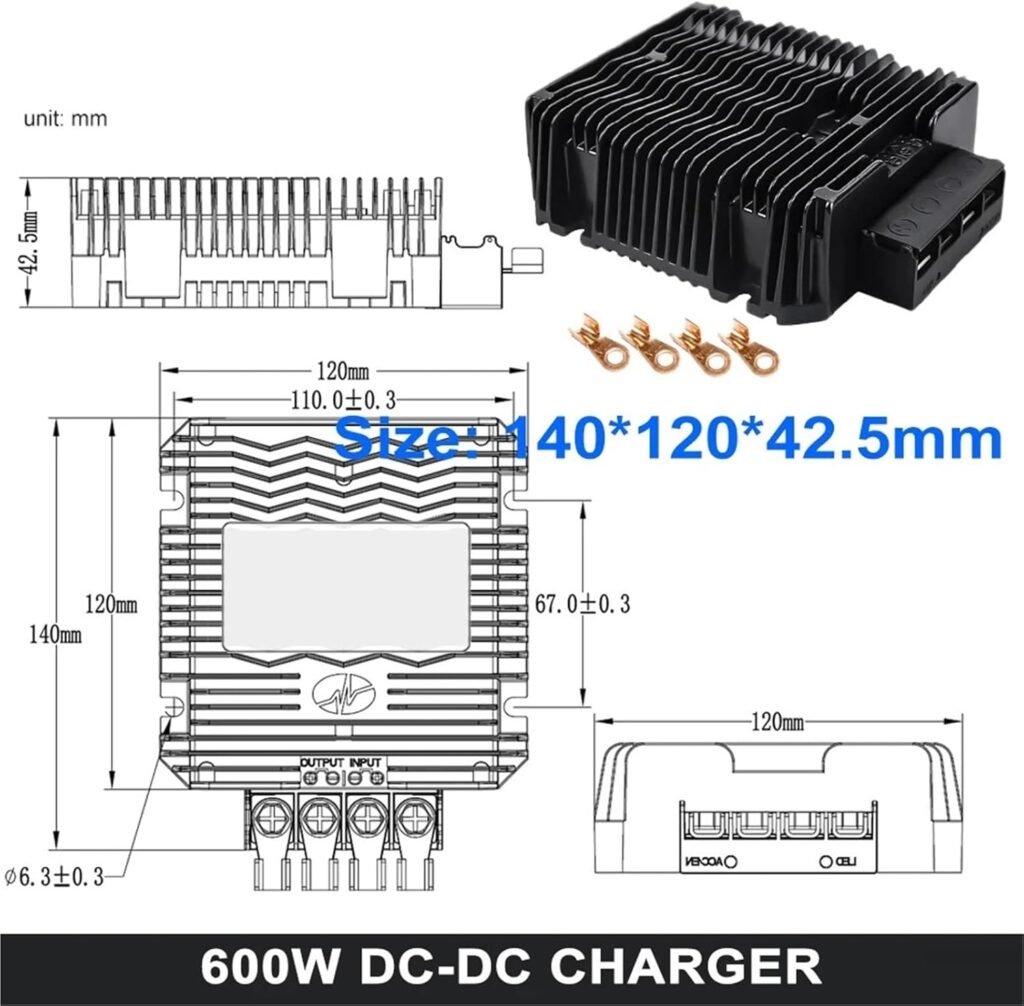
You’ll generally get the charger itself, mounting hardware, some wiring leads, and possibly a short manual. The model with ACC wire will include that extra pigtail. When you open the package, verify that all screws, connectors, and the ACC lead are present and undamaged.
Initial checklist for unboxing
Make sure the casing has no signs of shipping damage, the terminals are intact, mounting tabs are not bent, and any gaskets or silicone seals look present if the unit claims waterproofing. If the vendor included a user manual, read it to confirm wire color coding and any recommended fusing.
Design and build quality — what you’ll notice
The unit typically uses an aluminum casing for heat dissipation and a sealed design for water resistance. You’ll find that many budget and mid-range DC-DC chargers share the same rugged aesthetic, with fins and compact footprints for flexible mounting.
Feel and durability in the field
You should expect a solid-feeling housing and sturdy terminal blocks. Although it’s described as waterproof, the degree of water protection can vary by vendor. Install the unit where splashes are possible but avoid full submersion unless a specific IP rating is provided by the seller.
Installation and setup — step-by-step recommendations
Installing a DC-DC charger is straightforward if you follow safe wiring practices. You’ll wire the input to your starter battery/alternator circuit, the output to your LiFePO4 house battery, and place proper fusing close to the source.
Wiring sequence and fusing you should implement
Always fuse the input cable close to the source (starter battery or alternator). For a 20A charger you’ll likely use a fuse sized a bit above the charger’s max current (commonly 30A fuse), and for 10A you might use a 15A fuse — but follow the manufacturer’s explicit recommendations if available. Use appropriate wire gauges: 12 AWG is a good general choice for 20A, while 14 AWG can work for 10A, keeping wire length and voltage drop in mind.
Mounting location tips
Mount the charger inside a ventilated, dry location if possible — under a bench, in a locker, or in a weather-protected electronics bay. Keep it away from direct contact with salt spray, bilge water, or fuel sources. The ACC wire should be routed to an ignition-switched circuit or accessory circuit that is only active when the alternator or engine is running.

Charging behavior and performance you can expect
This charger provides a constant-current/constant-voltage (CC/CV) style charge appropriate for LiFePO4 chemistry. It raises the pack voltage at the selected setpoint and holds current until the voltage target is met, then reduces current to float/maintenance level if applicable.
Match to LiFePO4 charging profile
LiFePO4 typically charges near 3.6–3.65V per cell. The outputs listed (29.2V, 43.8V, 58.4V) correspond to those per-cell voltages for 8s, 12s, and 16s packs respectively. That means the charger is set up to give the correct bulk/top voltage for LiFePO4 chemistry, which prevents overcharge and extends battery life when used correctly.
Expected charging times
Charging speed depends on battery capacity and starting state of charge. With a 100Ah LiFePO4 battery, a 20A charger will theoretically deliver ~20A until near full, giving about 5 hours from very low to most of full (actual time longer due to tapering). A 10A unit will take roughly twice as long. These are rough estimates — your battery’s BMS, wiring resistance, and alternator output will affect real-world performance.
Thermal management and waterproofing — what to keep in mind
Even though the charger is marketed as waterproof, heat still needs to dissipate. The aluminum casing helps, but if you mount the unit in a poorly ventilated space, you may trigger thermal protection which reduces charging current.
Best practices for cooling and protection
Mount with some clearance around the case to allow natural convection, avoid mounting inside insulated boxes without ventilation, and keep the top and sides clear of clutter. If you plan to mount it outdoors or exposed to spray, verify seals and use additional weatherproofing at cable entry points.
Compatibility and use cases — where this charger fits
This charger is aimed at users who operate 12V vehicles but run 24V or 48V LiFePO4 house systems in RVs, boats, off-grid trailers, and other mobile applications. It’s ideal for dual-battery setups where you don’t want your vehicle’s starting battery tied directly to the house bank.
Typical setups you might use this in
- RVs: charging the house battery while driving, ensuring the alternator charges the starter battery normally.
- Boats: keeping the house LiFePO4 bank topped while the engine runs, with the ACC wire allowing ignition-only charging.
- Dual battery systems: isolating the house battery from starter battery to prevent starting battery drain.
Safety features and protections — what to expect and verify
Most modern DC-DC chargers include protections such as overcurrent, short circuit, reverse polarity protection, and thermal shutdown. These features are essential for safe charging and to protect your batteries and vehicle electronics.
Confirming protection on your unit
If the manual explicitly lists protections, follow its guidance. If the seller doesn’t provide a detailed spec sheet, treat the unit as having basic protections but install proper external fuses and a battery management system (BMS) on your LiFePO4 pack for full safety.
Monitoring, indicators, and user feedback
Many chargers include LED status indicators to show when the unit is charging, in float, or in fault state. The ACC wire also acts as a convenient control signal to let the charger turn on only when the vehicle is running.
What the ACC wire does for you
When you connect the ACC wire to a switched ignition or accessory terminal, the charger will only operate while the engine is running, reducing parasitic load on the starter battery and ensuring charging mainly occurs when the alternator is capable of handling the extra load.
Pros — why you might choose this charger
You’ll appreciate the unit if you need a rugged, multi-voltage DC/DC solution that specifically supports LiFePO4 chemistry and dual-battery systems. The ACC wire adds convenience, and the waterproof claim is attractive for marine or outdoor use.
Key positive points summarized
- LiFePO4-specific voltage outputs for 8s/12s/16s packs
- Available in 10A and 20A outputs to match different battery capacities
- ACC wire enables ignition-based control
- Compact and likely durable with a sealed housing for damp environments
Cons — potential drawbacks and limitations
You should be aware of a few limitations inherent to products in this category. The charging current is modest compared to larger DC-DC chargers, and the waterproof claim may not have a specific IP rating provided. Documentation and clear installation guides may be lacking with some sellers.
What might cause frustration
If you need very fast charging, a 20A charger may be underpowered for very large battery banks. Also, if your LiFePO4 battery pack’s BMS disconnects charging until a certain voltage is reached, you might need to wake the BMS or use a pre-charge routine. Always check documentation and ask the seller about IP ratings if you plan to expose the unit to real marine conditions.
Comparison to other DC-DC chargers — how it stacks up
Against well-known brands like Victron, Renogy, or Sterling, this unit is likely a budget or mid-range option. It covers the essential features you need for LiFePO4 charging but may lack advanced programmability, smartphone integration, or manufacturer support.
Practical differences you’ll notice
- Brand-name chargers often include app monitoring, detailed charge profile configurability, and verified IP ratings.
- This charger focuses on straightforward function with ACC control and multiple fixed output voltages, which may suit many users who want a simple, reliable solution without extra bells and whistles.
Troubleshooting common issues you might encounter
If the charger doesn’t work as expected, common causes include incorrect wiring, a blown fuse, the ACC wire not connected properly, or the battery’s BMS preventing charge due to low cell voltage or safety lockout.
Step-by-step checks to perform
- Confirm proper polarity at input and output. Reverse polarity protection may exist but avoid testing it.
- Check fuses at both input and output; replace any blown fuses with the correct type and rating.
- Ensure the ACC wire is connected to a switched ignition/accessory circuit or is bridged for testing.
- Measure voltage at the battery terminals to ensure the battery BMS isn’t isolating the pack.
- Verify wiring gauge and length — excessive voltage drop can prevent the unit from reaching its voltage setpoints.
Maintenance and long-term care tips
A DC-DC charger is low-maintenance, but a few checks will help it last. Periodically inspect connections for corrosion, verify seals, and keep the charger free of debris and dust that could impair heat dissipation.
Simple maintenance tasks you should schedule
- Every 3–6 months: inspect terminals and tighten any loose connections.
- After heavy exposure to salt air: rinse and dry the surrounding area and apply corrosion protectant to exposed metal connectors.
- If you notice overheating: check mounting and ventilation, and confirm the ambient temperature is within recommended operating range.
Tips for optimizing charging and battery life
To maximize battery longevity and charge efficiency, pair the charger with a proper LiFePO4 BMS and avoid frequent shallow charge/discharge cycles if possible. Use the correct output voltage matching your cell count and ensure the charger is fused and wired appropriately.
Practical tips to get the most from the charger
- Match the charger’s voltage setting exactly to your pack configuration (8s, 12s, 16s).
- Use the 20A version if you want faster charging of medium-sized banks; use the 10A for smaller banks or lower alternator loads.
- Wire the ACC to a true ignition-switched circuit to prevent parasitic draw when the vehicle is off.
Who this product is best for
You should consider this charger if you run LiFePO4 house batteries in an RV, boat, or trailer and need a compact, ignition-controlled charger to top up the pack while the engine runs. It’s well-suited for DIY systems and users who want a cost-effective way to convert 12V alternator power into a safe LiFePO4 charge for higher-voltage banks.
Scenarios where this charger excels
- You have an 8s/12s/16s LiFePO4 pack and want a simple charging solution on the road.
- You want a charger that can be enabled via ignition and won’t run down your starter battery when parked.
- You need a sealed unit that can tolerate splashes in a marine environment (check specific ratings).
Who might want to look elsewhere
If you need remote monitoring, programmable charge curves, higher output current for very large battery banks, or a guaranteed IP rating for continuous outdoor exposure, a premium branded DC-DC charger may be a better fit.
Alternatives to consider
Look at higher-end models if you want Bluetooth monitoring, solar MPPT integration, or larger current outputs (30A, 40A, etc.). Brand-name equipment often includes richer documentation, customer support, and verified certifications.
Final recommendation and buying checklist
If you want a compact, reasonably rugged DC-DC charger that supports LiFePO4 8s/12s/16s packs, and you don’t need premium monitoring features, this unit is a solid candidate. Before purchasing, confirm the exact model meets your voltage and current needs, check whether the ACC wire is included on the variant you choose, and verify the seller’s return policy and spec sheet.
Quick buying checklist for you
- Confirm the pack cell count and choose the correct voltage output (29.2V / 43.8V / 58.4V).
- Decide if you need the 10A or 20A output based on battery capacity.
- Ensure a model with ACC wire if you want ignition-controlled charging.
- Ask the seller about the waterproof rating and request a datasheet if not provided.
- Plan to install an appropriately rated fuse near the battery and use recommended wire gauges.
Frequently asked questions you may have
Q: Can this charger wake a LiFePO4 battery BMS that has fully disconnected low-voltage protection?
A: Often a BMS that disconnects due to undervoltage will only reconnect when charging at the correct voltage is applied. If the BMS remains closed, consult the battery manufacturer for the correct recovery procedure. Some systems need a pre-charge to the BMS or a manual reconnect.
Q: Can I mount it outside on my boat?
A: The unit is advertised as waterproof, but unless a precise IP rating is supplied, you should avoid continuous immersion. Mount it in a protected area with limited exposure to spray and ensure cable entry points are sealed.
Q: What wire size should I use for a 20A run?
A: Use 12 AWG for typical 20A runs, and keep the length short to minimize voltage drop. If your run is long, upsize the wire to 10 AWG for safer operation.
Q: Will it work with AGM or lead-acid batteries?
A: While it’s set up for LiFePO4 voltages, many DC-DC chargers have configurable profiles; check documentation. For lead-acid chemistry you’ll need a different charge profile (higher float, different absorption times) unless the unit specifically supports it.
Q: Can the ACC wire be used with a solar controller?
A: The ACC wire is intended for ignition or accessory circuits. You could wire it to a control output if you understand the logic levels and switching behavior, but it’s primarily designed to sense ignition status.
Disclosure: As an Amazon Associate, I earn from qualifying purchases.