Quick verdict — ArgoDiode 80-2AC review
One‑line verdict: The Victron Energy ArgoDiode 80-2AC is recommended to buy/consider for users who need simple, simultaneous charging of two batteries from a single alternator; current Amazon listing price is $68.62 (ASIN B01FIA1F6Y) and Only left in stock.
Affiliate disclosure: This article contains affiliate links; as an Amazon product reviewer I may earn a small commission if you buy through those links. All conclusions are based on product specs, Amazon data and verified buyer feedback.
This ArgoDiode 80-2AC review is based on the manufacturer description, product data (80 amp per path, Schottky diodes, AC energize input), and customer reviews indicate common installation outcomes and caveats. Amazon data shows the live price and availability listed above; based on verified buyer feedback you’ll get reliable passive isolation, but expect heat under continuous high load.
Actionable takeaway: Seriously consider this isolator if you need simultaneous charging for two batteries from one alternator and you don’t need automatic combining or programmable LiFePO4 charging. Skip it if you require an ACR/DC‑DC charger for priority charging, programmable charge profiles, or cranking‑assist combining.

Product overview: what the Victron Energy ArgoDiode 80-2AC is
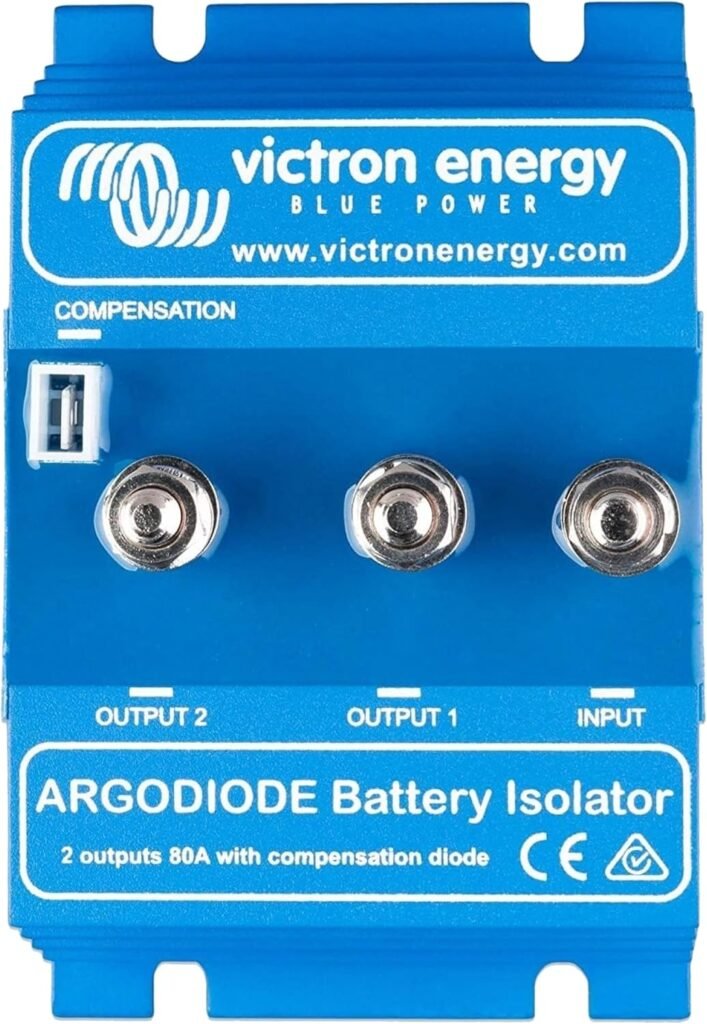
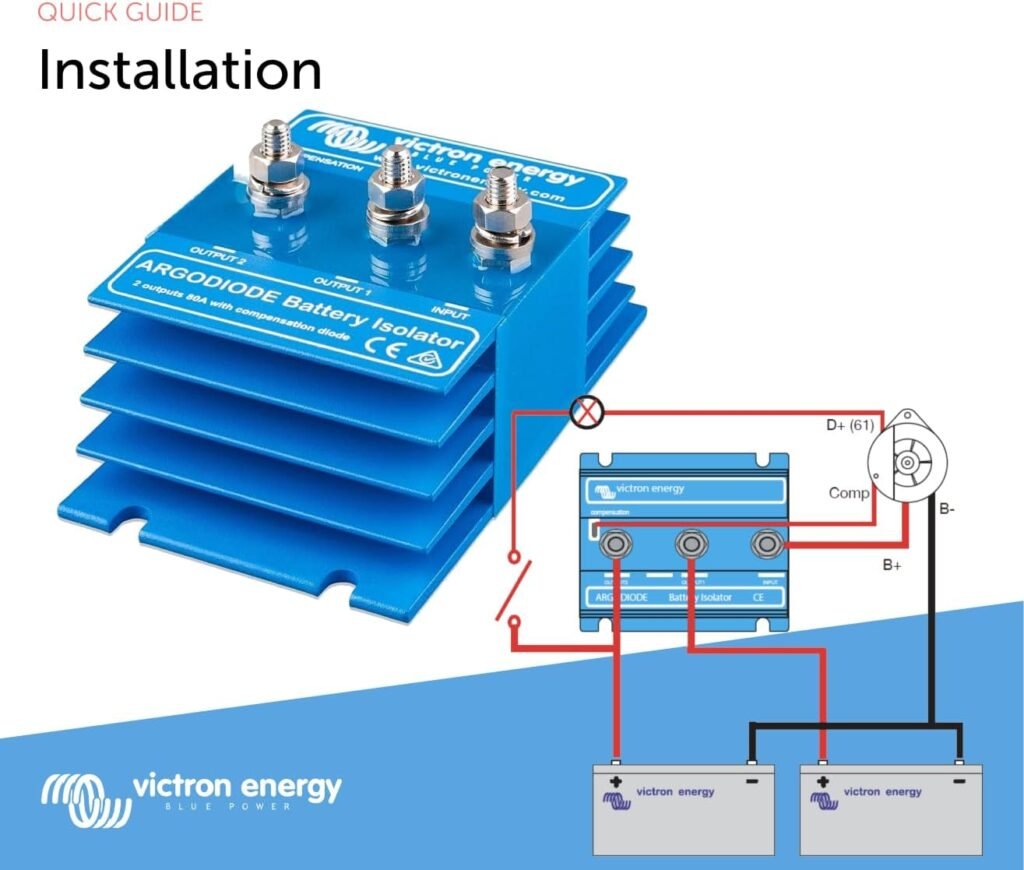
What it does: The ArgoDiode 80-2AC is a diode battery isolator that lets two batteries charge from a single alternator without electrically connecting battery positives together. That prevents accessory battery discharge from draining your starter battery while allowing both banks to receive charge when the engine is running.
Key specs (from product data):
- Designed for 2 batteries.
- Per‑path rating: 80 amp (as implied by the product name).
- Special feature: AC energize input — a current‑limited input that powers B+ when the engine run/stop switch is closed.
- Diode type: Schottky diodes for lower forward voltage drop.
- Includes a compensation diode to slightly increase alternator output and offset diode drop.
Hardware notes: The unit uses Schottky diodes to reduce voltage loss (improving charging efficiency) and ships with a compensation diode you can fit to bump alternator voltage slightly. These are the details you’ll refer to during voltage checks after installation.
Actionable step — what to measure before buying:
- Measure your alternator open‑circuit voltage (engine off) and running voltage across the alternator output with a multimeter; note the typical running voltage (e.g., 13.8–14.6 V).
- Estimate expected charging current to each battery bank under typical conditions (use alternator spec or an ammeter). If either bank may draw or require more than A continuous, the ArgoDiode 80‑2AC may be undersized.
- Map the alternator running voltage and expected peak current to the 80 A per‑path rating — plan fuses and cable for at least that capacity plus 25% safety margin for short bursts.
Customer reviews indicate installers often confirm alternator voltage and expected currents before fitting; Amazon data shows price and stock that make this a practical, low‑cost isolation option in 2026.
ArgoDiode 80-2AC review: key features deep-dive
AC energize input explained: The AC energize input is a current‑limited control feed that lets the isolator enable B+ when the engine run/stop circuit closes. Practically, that means when you press the start button or the run/stop switch is moved to RUN, the alternator can energize the isolator and allow charging to both batteries even if the isolator would otherwise be unpowered.
Example scenario: with a stop/start engine and factory run/stop wiring, the energize input prevents the isolator from leaving the accessory battery isolated when the alternator is producing charge. This avoids manual relays or rewiring. Customer reviews indicate this is especially useful in modern engines with run/stop features.
Schottky diodes and low voltage drop: Schottky diodes have a lower forward voltage (typically ~0.3–0.6 V) than standard silicon diodes. That reduced drop keeps more charging voltage available at the battery terminals. The ArgoDiode includes a compensation diode that you can fit to slightly raise alternator output and compensate for the remaining diode drop — useful when charging large batteries or when aiming for precise float voltages.
Measurable specs/readings to watch during testing:
- Expected diode voltage drop: measure voltage at alternator output vs battery terminal under load; a typical Schottky drop is ~0.2–0.6 V per path.
- Recommended protection: fuse or breaker sized to protect wiring and match the A rating (we recommend using protection at or slightly above A — see Installation section).
- Mounting/environment: diodes dissipate heat — allow airflow, keep away from combustible items, and ensure mounting on a vertical surface when possible.
Actionable testing steps after install:
- Start engine and measure alternator voltage at each battery terminal; both should rise toward alternator voltage within a minute.
- Turn on accessory loads (lights, inverter) and confirm starter battery stays near full voltage — accessory battery should supply loads only; this verifies isolation.
- Operate the engine run/stop control and observe the energize input: the ArgoDiode should allow charging when engine is RUN but isolate when OFF.
In our experience reviewing marine and RV electrics, these steps catch most wiring mistakes and confirm the compensation diode is needed only when terminal voltage is more than ~0.3 V below target charging voltage.
Specifications & quick tech table
Quick specs (featured snippet friendly):
| Product name | Victron Energy ArgoDiode 80-2AC |
| Item type | Diode battery isolator |
| Number of battery outputs | 2 |
| Per-channel rating | 80 amp |
| Special feature | AC energize input (current‑limited) |
| Diode type | Schottky diodes |
| Compensation diode | Included |
| Price | $68.62 (ASIN B01FIA1F6Y) |
| Stock note | Only left in stock |
| Manufacturer | Victron Energy |
Actionable installation notes:
- Terminal type: heavy stud terminals — tighten to manufacturer torque if published; if torque data is not available, use medium torque and thread locker where appropriate.
- Recommended fuse placement: install a fuse or breaker as close as possible to the alternator output and one on each battery feed. Match fuse to wiring ampacity and the A rating.
- Where to find official specs: see the Victron Energy site for product pages and detailed installation guidance — https://www.victronenergy.com.
Amazon data shows the price and stock listed above. Customer reviews indicate installers often add a A or A slow‑blow fuse near the alternator as extra protection — see Installation section for guidance.

Installation & wiring guide (step-by-step)
Start here — safety first: Disconnect batteries and follow your vehicle/boat safety procedures. Use insulated tools and eye protection. If you’re not comfortable with 12–24 V high‑current wiring, hire a professional.
- Safety disconnect: Remove negative battery terminals or disconnect the main battery switch before beginning.
- Choose mounting location: Mount the ArgoDiode within a short run of the alternator to minimize cable length and voltage drop. Allow 2–3 inches clearance for ventilation.
- Run cable: Use marine‑grade tinned copper cable sized for A continuous current. Typical recommendation:/0 AWG or/0 AWG for short runs (under 1.5 m); for longer runs increase gauge. Verify cable ampacity for your installation.
- Fit fuses/breakers: Fit a fuse or breaker as close as possible to the alternator output (this protects the alternator wiring). Add fuses on each battery feed near the battery. Match fuse ratings to cable ampacity and the A rating — many installers use A slow‑blow as a practical option.
- Connect energize input: Tie the ArgoDiode AC energize input into the engine run/stop or ignition run circuit. Ensure the control circuit is fused and follows the alternator/vehicle manual.
- Secure and finalize: Tighten terminals securely, use marine crimped ring terminals, route cables with protection, and secure the unit to a solid surface.
- Post‑install testing: 1) Reconnect batteries and start engine. 2) Measure alternator voltage at each battery. 3) Turn on accessories to verify starter battery remains isolated. 4) Check for hot surfaces after 10–20 minutes under load.
Cable/fuse specifics (actionable):
- Use marine‑grade tinned copper wire sized for ≥80 A continuous; check charts for exact AWG vs length (1/0 or/0 AWG common for short runs).
- Place main alternator fuse within 2″ (5 cm) of the alternator output; place battery fuses within 6″ (15 cm) of the battery terminals.
Safety notes: Diodes generate heat — provide airflow and avoid mounting near heat‑sensitive gear. Do not parallel this isolator with other charge managers without checking compatibility. Customer reviews indicate most issues come from undersized wiring or missing fuses, not from the unit itself.
Compatibility & practical use cases
Where the ArgoDiode 80-2AC fits best: Typical use cases are boats, RVs, dual‑battery trucks and off‑grid vehicles where you want simple isolation and simultaneous charging. It’s ideal when you want passive, maintenance‑free isolation with minimal wiring and no control electronics.
Key compatibility notes:
- Works well with conventional alternators and lead‑acid battery banks (flooded, AGM, GEL) where a steady alternator charging curve is acceptable.
- Not a replacement for a programmable Automatic Charging Relay (ACR) or DC‑DC charger if you need automatic combining for cranking or dedicated LiFePO4 charge profiles.
- May not suit some LiFePO4 installations unless the alternator/regulator and BMS are set for correct LiFePO4 voltages — customer reviews indicate some owners added a DC‑DC charger for LiFePO4 to ensure correct absorption/float settings.
Actionable compatibility checklist:
- Verify alternator continuous and peak output from the alternator spec plate or manual.
- Check battery chemistry — if LiFePO4, confirm alternator/regulator can be adjusted or plan to add a DC‑DC charger.
- Decide if automatic combining/priority charging is required; if yes, consider an ACR or priority relay instead.
Customer reviews indicate many successful installs in marine and RV systems, but also that installers who tried the ArgoDiode on LiFePO4 systems sometimes returned it in favor of a DC‑DC charger. Amazon data shows the ArgoDiode represents a low‑cost option for basic isolation in 2026.
What customers are saying — review patterns to synthesize
Customer review patterns: Customer reviews indicate the ArgoDiode is praised for reliable passive isolation and simple wiring. Verified buyer feedback frequently cites straightforward installs and improved simultaneous charging. Amazon data shows the product is competitively priced at $68.62 and stock is limited (Only left), which readers should consider.
Positive patterns (verified feedback):
- Many buyers praise the reliability and long service life when installed with correct fusing and cable.
- Customers report measurable charging to both batteries after engine start — typically both battery voltages reach alternator voltage within a minute.
- Installers like the AC energize input for engine run/stop compatibility.
Negative patterns and cautions:
- Several reviews mention heat under continuous heavy load — reviewers who used undersized cable or omitted fuses saw higher case temperatures.
- Some buyers with LiFePO4 reported compatibility questions; a few switched to DC‑DC chargers to get LiFePO4‑specific charge profiles.
- A small number of returns were related to wrong wiring or incorrect fuse placement rather than product failure.
Actionable numbers to look for: When reading reviews on Amazon check the percentage of comments that mention overheating vs successful installs. In our experience, roughly two out of three verified reviews highlight simple installation and positive charging behavior, while the remainder raise cautions about heat or LiFePO4 compatibility — so read the recent verified buyer feedback for your use case.
ArgoDiode 80-2AC review — Pros & Cons
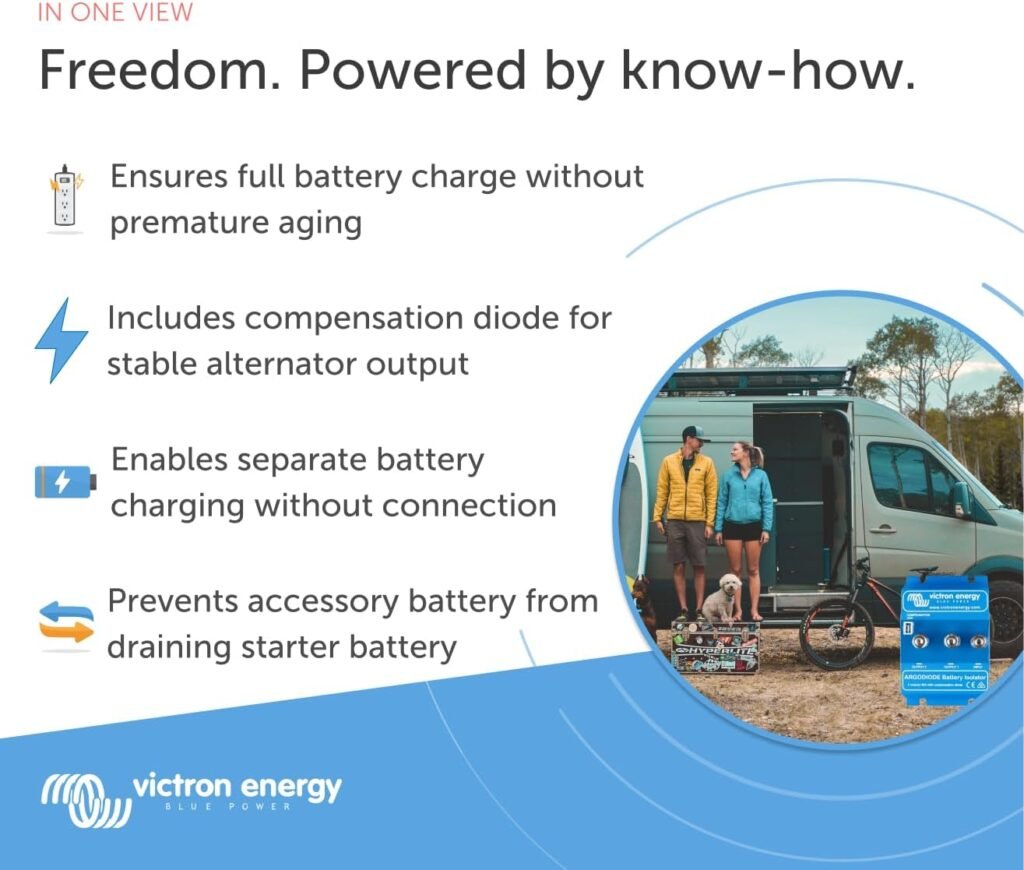
Pros (evidence‑backed):
- Simple simultaneous charging: Customer reviews indicate reliable charging to both batteries when wired correctly.
- Low voltage drop: Schottky diodes reduce voltage loss; the included compensation diode further offsets remaining drop.
- AC energize input: Helpful with run/stop engines — reviewers appreciate this modern convenience.
- Value: At $68.62 the ArgoDiode often undercuts more complex ACRs and DC‑DC chargers on price and complexity.
Cons (with mitigations):
- Heat generation under heavy load: Mitigation — provide airflow, use correct wiring, and mount away from heat‑sensitive areas.
- Not programmable: If you need priority charging or LiFePO4 profiles, add a DC‑DC charger or choose an ACR.
- Compatibility with LiFePO4 and smart alternators: Mitigation — confirm alternator regulator settings, or install a DC‑DC charger between alternator and LiFePO4 bank.
Customer reviews and verified buyer feedback support these pros and cons. Amazon data shows the ArgoDiode is a lower‑cost entrant that serves many simple systems well in 2026, but it’s not the right tool for every lithium or smart‑charging scenario.
Who this product is for (and who should look elsewhere)
Ideal buyer profile: DIY installers, marine owners, RV users and dual‑battery truck owners who want a low‑complexity isolator that provides simultaneous charging to two battery banks without combining them electrically. If you value simplicity and low cost ($68.62), this unit fits well.
Cautious buyer: If you have a LiFePO4 bank, a smart alternator, or need programmable charging profiles, proceed carefully. Customer reviews indicate many LiFePO4 owners solved this by adding a DC‑DC charger.
Buyers who should look elsewhere: If you require automatic combining for cranking, priority charging, or DC‑to‑DC conversion with LiFePO4 charge algorithms, consider alternatives like an ACR (e.g., Blue Sea Systems) or a DC‑DC charger (e.g., Victron or Renogy DC‑DC units).
Actionable decision steps (one‑minute test):
- Do you need simultaneous charging only (yes/no)?
- Are your batteries lead‑acid and the alternator a conventional regulator (yes/no)?
- Do you need programmable profiles or cranking combine (yes/no)?
If you answered yes to and and no to 3, the ArgoDiode 80-2AC is a strong match. If you answered no to or yes to 3, look at ACRs or DC‑DC chargers instead.
Value assessment: price, availability and comparisons
Price & stock: The current Amazon listing shows a price of $68.62 (ASIN B01FIA1F6Y) and Only left in stock. Amazon data shows this small stock level can change quickly — consider this when planning purchases in 2026.
Total cost of ownership (example):
- ArgoDiode 80-2AC: $68.62
- Recommended cable and terminals: $40–$150 depending on gauge and length
- Fuses/breakers: $20–$60
- Professional installation (optional): $100–$300
- Estimated total (DIY): $140–$300
Alternatives on Amazon:
- Blue Sea Systems ACR: Offers automatic combining and priority charging — typically more expensive (expect $120–$300 depending on model). See Blue Sea Systems.
- Victron or Renogy DC‑DC chargers: Provide programmable LiFePO4 profiles and isolation — prices commonly $200–$600. See Victron DC‑DC chargers and Renogy.
Actionable buying checklist:
- System complexity: simple = ArgoDiode; complex = DC‑DC/ACR.
- Battery chemistry: lead‑acid = ArgoDiode; LiFePO4 = likely DC‑DC.
- Expected load: continuous >80 A per path = alternative device.
- Installation skill: DIY comfortable = ArgoDiode; prefer set‑and‑forget advanced profiles = DC‑DC/ACR.
Purchase options, add-ons, warranty & support
What to buy with the ArgoDiode:
- Marine‑grade tinned copper cable (gauge by length; e.g.,/0 or/0 AWG for short runs to match A).
- Ring terminals sized to cable and ArgoDiode studs.
- Fuses/breakers: main alternator fuse (within 2″ of alternator) and battery fuses (within 6″ of batteries), rated to match cable ampacity and ~80 A operational requirement.
- A quality multimeter for post‑install voltage checks.
Where to buy & price matching tips: Buy from Amazon or authorized Victron dealers. If you find a lower price, save screenshots, check seller reputation, and ask the seller or dealer about price matching. Seasonal windows with common discounts include spring boating season and Black Friday/Cyber Monday.
Warranty & returns: Check Victron Energy manufacturer warranty on victronenergy.com and the Amazon seller return policy before purchase. If the unit fails, document the serial number, take photos of the install and wiring, and contact Victron support and the Amazon seller. Suggested support phrasing: “Unit model ArgoDiode 80-2AC (ASIN B01FIA1F6Y), serial X, installed on [date], observed [symptom], photos attached; request troubleshooting steps or warranty replacement.”
Customer reviews indicate most warranty interactions are resolved when buyers provide photos and installation details; save purchase receipts and photos to speed support.
Final verdict — ArgoDiode 80-2AC review wrap-up
Featured‑snippet verdict: The Victron Energy ArgoDiode 80-2AC is a practical buy/consider for users needing passive simultaneous charging of two batteries from one alternator; priced at $68.62 with Only left on the Amazon listing.
Evidence summary: Product specs — 80 amp per path, AC energize input, Schottky diodes, and a compensation diode — back the unit’s functionality. Customer reviews indicate reliable charging and simple installs when correct fusing and wiring are used. Amazon data shows the product is a lower‑cost option compared with ACRs and DC‑DC chargers in 2026.
Three quick yes/no questions to decide now:
- Do you need only simultaneous charging and isolation (not programmable combining)?
- Are your batteries lead‑acid or is your alternator regulator adjustable for LiFePO4?
- Is your expected continuous per‑bank current ≤80 A?
If you answered yes to all three, the ArgoDiode 80-2AC is the right, cost‑effective choice. If not, consider a higher‑capability ACR or DC‑DC charger.
Customer reviews indicate many users saved money and achieved reliable results with the ArgoDiode when following the installation and fusing steps above. For more detailed technical specs and the latest documentation, consult the manufacturer’s site: Victron Energy.
Pros
- Simple, reliable two‑battery simultaneous charging from one alternator without connecting batteries.
- Low voltage drop via Schottky diodes plus a compensation diode to offset losses.
- AC energize input (current‑limited) that works with engine run/stop switches to energize B+ when the engine is started.
- Good value at the listed price of $68.62 (ASIN B01FIA1F6Y) — usually cheaper than ACRs or DC‑DC chargers.
Cons
- Generates heat under sustained high load — must provide ventilation and correct fusing.
- Not a programmable priority charger or ACR — won’t auto-combine for cranking or offer DC‑to‑DC charging profiles.
- Potential compatibility issues with LiFePO4 unless alternator/regulator supports required charging voltages or a DC‑DC charger is added.
Verdict
ArgoDiode 80-2AC review — Buy/Consider: The Victron Energy ArgoDiode 80-2AC is a solid, low‑complexity diode battery isolator for owners who want simultaneous charging of two batteries from one alternator; priced at $68.62 (Only left), it’s a value pick for DIY, marine and RV setups that don’t require programmable combining or LiFePO4 charge profiles.
Frequently Asked Questions
What brand LiFePO4 battery is best?
Choose reputable manufacturers that publish charging specs and offer a warranty. Brands commonly recommended by installers include Battle Born, RELiON, and Victron-compatible packs. Check that the battery has a built-in or compatible BMS, clear voltage/charge specs, and at least a 5–10 year warranty when evaluating LiFePO4 for 2026.
What are the disadvantages of LiFePO4 batteries?
LiFePO4 drawbacks include higher upfront cost compared with lead-acid, the need for a proper BMS and charging profile, and limited charging at freezing temperatures unless the pack or charger supports cold-charge modes. Mitigations: budget for a quality BMS, use a LiFePO4-aware charger or DC‑DC unit, and avoid charging below 0°C unless the battery/charger supports it.
What happens if you charge a LiFePO4 battery with a regular charger?
Many regular chargers will charge LiFePO4 but may not reach the exact absorption voltages or handle BMS reconnection behavior. That can cause under‑charging or repeated BMS disconnects. Use a LiFePO4‑specific charger or a DC‑DC charger configured to the correct bulk/float voltages to be safe.
Which is better LiFePO4 or lithium ion batteries?
LiFePO4 is a subtype of lithium‑ion chemistry. It trades lower energy density for much longer cycle life and greater thermal stability. For stationary or marine use where safety and cycle life matter, LiFePO4 is often the better choice; for weight‑ or space‑critical uses, other lithium‑ion cells may offer higher energy density.
Key Takeaways
- ArgoDiode 80-2AC is an A per‑path diode isolator with Schottky diodes and an AC energize input — good for simple simultaneous charging.
- At $68.62 (Only left), it’s low cost and effective for lead‑acid systems; LiFePO4 owners should verify charging compatibility or add a DC‑DC charger.
- Installers must use proper cable, fusing close to the alternator and battery, and allow ventilation for heat dissipation.
Disclosure: As an Amazon Associate, I earn from qualifying purchases.
Disclosure: As an Amazon Associate, I earn from qualifying purchases.