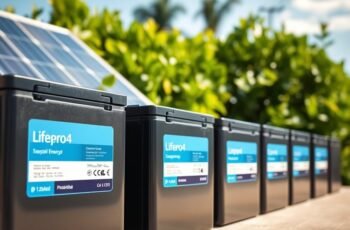
Did you know that LiFePO₄ batteries can last up to 5,000 charge cycles, far exceeding traditional lithium-ion options? Their superior thermal stability and safety profile make them an increasingly popular choice for various applications. Understanding these advantages can substantially impact energy storage decisions, but what truly sets them apart? Let’s explore the key factors that make LiFePO₄ batteries a reliable and sustainable energy solution.
Key Takeaways
- LiFePO₄ batteries offer superior thermal stability, reducing overheating and fire hazards during operation.
- They have a long lifespan, typically lasting between 2,000 to 5,000 charge cycles, ensuring durability.
- The non-toxic and stable chemistry facilitates easier recycling and environmentally friendly use.
- High cycle life and consistent voltage output improve system efficiency and reliability.
- They maintain safety through inherent resistance to thermal runaway, overcharging, and mechanical impacts.
What Are Lifepo4 Batteries and How Do They Work?
Lifepo4 batteries, also known as lithium iron phosphate batteries, are a type of rechargeable lithium-ion battery characterized by their use of a phosphate-based cathode material. Their battery chemistry involves stable FePO4 cathodes and graphite anodes, which contribute to enhanced thermal stability and cycle life. During charging, strict protocols must be followed to prevent overvoltage and ensure safety; typically, a CC/CV (constant current/constant voltage) method is employed. These protocols optimize energy transfer and prolong battery lifespan. Unlike other lithium-ion chemistries, Lifepo4 batteries operate within a voltage window of about 3.2 to 3.3 volts per cell, guaranteeing consistent performance. This precise chemistry and adherence to charging protocols make Lifepo4 batteries reliable, efficient, and suitable for high-demand applications.
Why Are Lifepo4 Batteries Safer Than Traditional Lithium-Ion?
Lifepo4 batteries offer superior thermal stability, which minimizes the risk of overheating during operation. Their robust chemical structure reduces the likelihood of thermal runaway and fire hazards common in traditional lithium-ion batteries. Additionally, the enhanced structural integrity of Lifepo4 cells contributes to greater safety under mechanical stress.
Thermal Stability Advantage
Because of their inherent chemical composition, lithium iron phosphate batteries exhibit markedly higher thermal stability than traditional lithium-ion batteries. This enhanced heat resistance considerably improves safety through better thermal management, reducing the risk of overheating. The stability stems from the strong chemical bonds in LiFePO₄, which resist decomposition at elevated temperatures.
Key thermal stability advantages include:
- *Lower risk of thermal runaway*, even under high load or external heat sources.
- *Consistent performance* across a broad temperature range, maintaining efficiency during heat fluctuations.
- *Reduced need for complex cooling systems*, simplifying battery design and enhancing safety.
These factors make Lifepo4 batteries inherently safer, ensuring reliable operation and minimizing thermal-related hazards.
Reduced Fire Risk
While traditional lithium-ion batteries are susceptible to thermal runaway due to their chemical composition, Lifepo4 batteries inherently pose a lower fire risk. This increased safety stems from their stable chemistry, which resists overheating and internal short circuits. Lifepo4 cells do not produce oxygen during failure, unlike other lithium-ion chemistries, markedly reducing the likelihood of fire propagation. Effective fire prevention relies on rigorous safety protocols, such as thermal management systems and protective circuitry, which further mitigate risks. The inherent chemical stability of Lifepo4 batteries means that even under abuse or fault conditions, the probability of ignition remains minimal. This safety profile makes them especially suitable for applications demanding high safety standards, where reducing fire hazards is paramount.
Enhanced Structural Integrity
The structural integrity of Lifepo4 batteries contributes considerably to their safety profile, setting them apart from traditional lithium-ion chemistries. This is primarily due to superior structural reinforcement and material durability, which resist deformation and failure under stress. Lifepo4’s robust crystal lattice provides enhanced resilience against thermal and mechanical shocks. Specifically:
- The rigid casing prevents internal component deformation during impacts.
- The durable cathode material maintains stability under high charge cycles.
- The electrolyte composition reduces the risk of dendrite formation, minimizing internal short circuits.
These factors work collectively to ensure the battery maintains its integrity throughout operational stresses. This enhanced structural reinforcement greatly reduces safety hazards, making Lifepo4 batteries a safer choice for demanding applications.
How Long Do Lifepo4 Batteries Last and What Affects Their Lifespan?
Lifepo4 batteries are known for their impressive longevity, often surpassing other lithium-ion chemistries, but their lifespan is influenced by several key factors. The typical lifespan ranges from 2,000 to 5,000 charge cycles, depending on usage conditions. Proper battery recycling practices help maintain peak performance and prevent premature degradation, indirectly extending lifespan. Accurate lifespan estimation relies on understanding factors like charge/discharge rates, operating temperature, and depth of discharge. High temperatures accelerate capacity fade, while shallow cycling preserves battery health longer. Consistent, controlled charging protocols minimize stress and prolong cycle life. Ultimately, diligent management and adherence to manufacturer guidelines are essential for maximizing the durability of Lifepo4 batteries over their operational life.
What Are the Key Performance Benefits of Lifepo4 Batteries?
Lifepo4 batteries offer several performance advantages that make them a popular choice for energy storage applications. Their high cycle life guarantees durability, reducing the need for frequent replacements. They also maintain consistent voltage output, optimizing system efficiency. Additionally, their inherent safety features minimize risks related to thermal runaway and overcharging. From an environmental perspective, Lifepo4 batteries are more sustainable due to their non-toxic chemistry, facilitating easier battery recycling and reducing environmental impact. These batteries support long-term operational stability, which is vital for large-scale energy systems. Their resilience against extreme temperatures further enhances reliability. Overall, Lifepo4 batteries deliver reliable performance, safety, and eco-friendliness that meet the demanding needs of modern energy storage solutions.
How Do Lifepo4 Batteries Support Renewable Energy Storage?
Because renewable energy sources like solar and wind are inherently variable, effective energy storage solutions are vital to guarantee a reliable power supply. Lifepo4 batteries excel in supporting renewable integration by providing stable, high-performance storage that can efficiently capture excess energy during peak production. Their long cycle life and high charge/discharge efficiency enhance grid stability, enabling consistent energy delivery regardless of generation variability. Lifepo4 batteries’ rapid response times help smooth out fluctuations, preventing grid disturbances caused by intermittent renewable sources. These attributes make them ideal for balancing supply and demand, facilitating the integration of renewables into existing power systems. As a result, Lifepo4 batteries play a pivotal role in creating resilient, sustainable energy infrastructure with reliable renewable energy storage capabilities.
What Are the Cost Considerations for Choosing Lifepo4 Batteries?
When evaluating the adoption of lithium iron phosphate (LiFePO4) batteries for energy storage, cost considerations become a significant factor. Market pricing of LiFePO4 batteries is generally higher upfront compared to traditional lead-acid options. However, analyzing long-term costs reveals notable advantages.
Key factors include:
- Initial Investment: Higher purchase price impacts short-term budgets.
- Durability and Lifecycle: LiFePO4 batteries often last 2-3 times longer, reducing replacement costs.
- Efficiency Gains: Better charge retention and fewer maintenance needs lower operational expenses over time.
These elements demonstrate that, despite higher initial costs, the total cost of ownership favors LiFePO4 batteries, making them a cost-effective solution for sustainable energy storage.
How Do You Properly Maintain and Safely Use Lifepo4 Batteries?
Proper maintenance and safe use of LiFePO4 batteries are essential to guarantee peak performance and longevity. Adhering to strict safety protocols and consistent maintenance routines minimizes risks and preserves battery health. Always monitor voltage levels and avoid overcharging or deep discharging, which can reduce lifespan. Use a compatible Battery Management System (BMS) to prevent thermal runaway and ensure balanced cell operation. Store batteries in a cool, dry environment, avoiding extreme temperatures. Regularly inspect for physical damage and corrosion.
| Condition | Action |
|---|---|
| Overvoltage | Disconnect immediately |
| Physical Damage | Replace or repair before use |
| Thermal Management | Maintain proper ventilation and cooling |
Frequently Asked Questions
Are Lifepo4 Batteries Environmentally Friendly and Recyclable?
We believe Lifepo4 batteries are environmentally friendly and recyclable due to their safe recycling processes, which reduce environmental impact. Their stable chemistry minimizes harmful emissions, making them a responsible choice for sustainable energy storage solutions.
Can Lifepo4 Batteries Operate Effectively in Extreme Temperatures?
We find that Lifepo4 batteries, true to form, can handle extreme temperatures with impressive resilience. Their temperature resilience guarantees consistent battery performance, making them a reliable choice even in challenging conditions, and they won’t break a sweat.
How Do Lifepo4 Batteries Compare to Other Lithium-Based Batteries?
We find Lifepo4 batteries superior to other lithium-based options regarding battery lifespan and cost efficiency, thanks to their stable chemistry and deeper cycle life, making them a technically reliable and economically advantageous choice for various applications.
Are Lifepo4 Batteries Suitable for Mobile or Portable Applications?
We believe Lifepo4 batteries excel in portable power and mobile energy due to their high safety, long cycle life, and stable performance. Despite slightly lower energy density, they reliably power mobile devices and remote systems in demanding conditions.
What Are the Common Signs Indicating a Lifepo4 Battery Needs Replacement?
We observe that Lifepo4 batteries typically need replacement when their battery lifespan diminishes considerably, charging indicators show irregularities, or performance drops sharply, signaling reduced capacity and efficiency, which are clear signs to contemplate a replacement.
Conclusion
In summary, LiFePO₄ batteries prove that safety, durability, and sustainability can coexist in energy storage—remarkably, without demanding a PhD to operate or a fortune to replace. While they may cost a bit more upfront, their long lifespan and eco-friendly profile make them a wise choice. After all, in a world increasingly dependent on renewable energy, choosing LiFePO₄ isn’t just smart—it’s practically a civic duty. Now, who wouldn’t want to battery-proof their future?